English
 Español
 tiếng việt
 русский
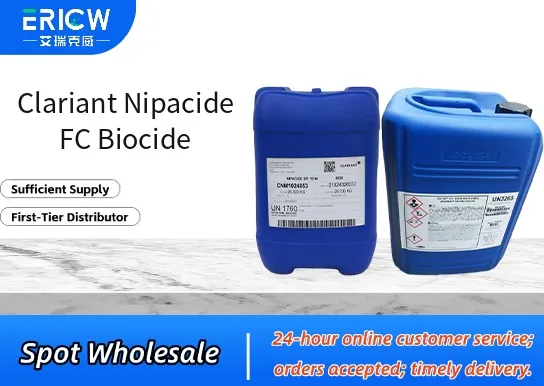
Highly effective broad-spectrum biocide against bacteria, fungi, and algae.
Low-toxicity formulation designed for safer handling and reduced environmental impact.
Excellent stability in a wide pH range (pH 4–10) and under varying temperature conditions.
Compatible with common industrial water treatment additives and polymer systems.
Non-oxidizing mode of action helps prevent corrosion and material degradation in recirculating systems.
Industrial cooling water systems including open recirculating towers.
Process water circuits in paper, textile, and food processing facilities.
Oilfield injection water and produced water treatment programs.
Preservation of water-based metalworking fluids and hydraulic emulsions.
Control of microbial growth in pigment dispersions and architectural coatings.
| Chemical Type | Isothiazolinone-based biocide blend |
| Product Form | Liquid concentrate |
| Appearance | Clear to slightly hazy, pale yellow liquid |
| Primary Applications | Cooling water, process water, metalworking fluids, coatings |
| Key Features | Broad-spectrum efficacy, non-oxidizing, pH-stable |
| Benefits | Reduced biofilm formation, extended fluid life, low corrosion risk |
| Storage Conditions | Store between 5°C and 35°C; protect from freezing and direct sunlight |
| Shelf Life | 24 months in original unopened container |
Q1: What is the primary mode of action of Nipacide FC Biocide?
A: Nipacide FC Biocide functions as a broad-spectrum preservative through disruption of microbial cell membranes and interference with essential metabolic processes, effectively controlling bacteria, yeasts, and molds in water-based systems.
Q2: In which types of industrial formulations is Nipacide FC commonly used?
A: It is widely applied in water-based coatings, adhesives, construction chemicals, metalworking fluids, and cleaning concentrates where long-term microbiological stability is required during storage and use.
Q3: Is Nipacide FC compatible with common thickeners and surfactants?
A: Yes, Nipacide FC demonstrates good compatibility with associative and non-associative thickeners, anionic and nonionic surfactants, and most common formulation ingredients—though compatibility testing under actual use conditions is recommended for new formulations.
Q4: How should Nipacide FC be added to a formulation?
A: It is typically added during the cool-down phase, after high-shear mixing and pH adjustment, to minimize degradation and ensure uniform distribution. Pre-dilution with water or a compatible solvent may improve dispersion in viscous systems.
Q5: Does Nipacide FC require pH adjustment for optimal performance?
A: Performance is generally robust across a wide pH range (approximately 4–10), though maximum efficacy is typically observed in mildly acidic to neutral conditions. Significant deviations outside this range may reduce stability or antimicrobial activity.
Contact With Us:
E-mail: wangxingqiang@ericwchem.com
Have a Questions? Call Us:
Add:
Building A1, Jiete Industrial Park, Huangpu District, Guangzhou City, Guangdong Province, China