English
 Español
 tiếng việt
 русский
High melt flow index for excellent processability in extrusion and injection molding
Outstanding low-temperature flexibility and impact resistance
Excellent compatibility with polypropylene (PP) and polyethylene (PE) for enhanced blend performance
Good UV stability and long-term weathering resistance
Low density and high elasticity ideal for soft-touch applications
Automotive interior trim including door panels and instrument bezels
Flexible packaging films requiring toughness and seal integrity
Soft-grip overmolding for power tools and consumer electronics
Weather-resistant seals and gaskets for building & construction
Thermoplastic elastomer (TPE) replacement in durable goods components
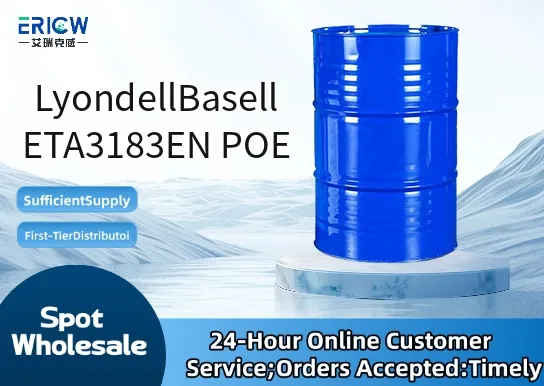
| Chemical Type | Ethylene-octene copolymer (POE) |
| Product Form | Pellets |
| Appearance | Off-white, free-flowing pellets |
| Melt Flow Index (190°C/2.16 kg) | 3.0 g/10 min |
| Density (ASTM D792) | 0.870 g/cm³ |
| Octene Content | Approx. 20 wt% |
| Primary Applications | PP/PE modification, soft-touch overmolding, flexible packaging |
| Key Features | High elasticity, low-temperature resilience, processing versatility |
Q1: What is the primary function of ETA3183EN POE in polymer formulations?
A: ETA3183EN is a polyolefin elastomer (POE) designed primarily as a toughening agent and impact modifier for polypropylene and other polyolefin-based systems. It enhances low-temperature impact resistance and improves melt processability without significantly compromising stiffness or thermal stability.
Q2: Is ETA3183EN suitable for use in food-contact or medical-grade applications?
A: ETA3183EN is not pre-qualified for direct food-contact or medical device applications. Its suitability for such uses depends on full regulatory assessment by the end-user, including evaluation of final formulation, processing conditions, and applicable regional requirements. LyondellBasell recommends consulting technical service for guidance on compliance pathways.
Q3: How does ETA3183EN compare to ethylene-propylene rubber (EPR) or EPDM in polypropylene blends?
A: Unlike conventional EPR or EPDM, ETA3183EN offers superior compatibility with polypropylene due to its controlled ethylene/propylene ratio and narrow molecular weight distribution. This typically results in finer dispersion, improved interfacial adhesion, and more consistent mechanical performance—especially in injection-molded parts requiring balanced toughness and dimensional stability.
Q4: What are typical processing recommendations for ETA3183EN?
A: ETA3183EN processes well using standard polyolefin equipment—including extruders and injection molding machines. Drying is generally not required under normal ambient conditions, but extended storage in humid environments may warrant mild drying (e.g., 60–70 °C for 2–4 hours). Melt temperatures typically range from 190 °C to 230 °C, depending on base resin and equipment configuration.
Contact With Us:
E-mail: wangxingqiang@ericwchem.com
Have a Questions? Call Us:
Add:
Building A1, Jiete Industrial Park, Huangpu District, Guangzhou City, Guangdong Province, China