English
 Español
 tiếng việt
 русский
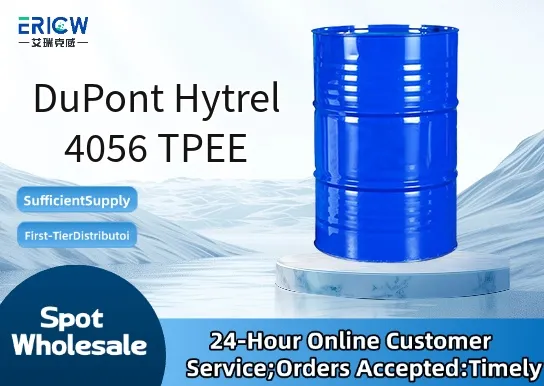
Excellent balance of thermoplastic processability and elastomeric performance.
High resilience and low compression set for dynamic sealing and repeated flexing applications.
Good resistance to oils, greases, and common automotive fluids at elevated temperatures.
Outstanding fatigue resistance over a wide temperature range (–40 °C to 120 °C).
Easy to process via injection molding, extrusion, and blow molding without pre-drying.
Automotive air ducts and HVAC components.
Fuel system connectors and vapor recovery lines.
Power tool grips and ergonomic handles requiring vibration damping.
Industrial hose covers and flexible couplings.
Consumer appliance seals and gaskets exposed to thermal cycling.
| Chemical Type | Thermoplastic Polyester Elastomer (TPEE) |
| Product Form | Pellets |
| Appearance | Off-white to light tan, free-flowing granules |
| Primary Applications | Dynamic seals, flexible ducting, fluid handling components |
| Key Features | High elasticity, thermal stability, hydrolysis resistance |
| Benefits | Reduced part count vs. multi-material assemblies; recyclable thermoplastic processing |
| Density (ASTM D792) | 1.18 g/cm³ |
| Melt Flow Rate (230 °C/2.16 kg, ASTM D1238) | 20 g/10 min |
Q1: What are the key mechanical advantages of Hytrel 4056 compared to other TPEEs or thermoplastic elastomers?
A: Hytrel 4056 offers an excellent balance of high tensile strength, outstanding flex fatigue resistance, and good recovery after repeated deformation—making it especially suitable for dynamic, stress-intensive applications such as automotive air ducts, power tool grips, and flexible couplings. Its polyester-based chemistry provides superior creep resistance and dimensional stability over polyether-based TPEs at elevated temperatures.
Q2: Can Hytrel 4056 be processed using standard thermoplastic equipment?
A: Yes, Hytrel 4056 is fully compatible with conventional thermoplastic processing methods including injection molding, extrusion, and blow molding. It requires typical drying prior to processing (e.g., 4–6 hours at 120 °C under desiccant conditions) and exhibits good melt stability and flow characteristics across a broad processing window.
Q3: How does Hytrel 4056 perform in contact with oils, greases, and common automotive fluids?
A: Hytrel 4056 demonstrates good resistance to many non-polar fluids—including mineral oils, synthetic lubricants, and hydraulic fluids—due to its semi-crystalline polyester structure. While not intended for prolonged immersion in aggressive solvents or strong oxidizing agents, it maintains mechanical integrity and surface appearance better than many styrenic or olefinic TPEs under intermittent exposure.
Q4: Is Hytrel 4056 suitable for applications requiring regulatory compliance for food contact or medical use?
A: Hytrel 4056 is not specifically formulated or certified for direct food-contact or medical device applications. For such uses, DuPont offers other Hytrel grades with appropriate regulatory support—consult the latest DuPont Regulatory Compliance Documentation or contact DuPont Technical Service for guidance on compliant alternatives.
Contact With Us:
E-mail: wangxingqiang@ericwchem.com
Have a Questions? Call Us:
Add:
Building A1, Jiete Industrial Park, Huangpu District, Guangzhou City, Guangdong Province, China