English
 Español
 tiếng việt
 русский
High reactivity with polyols, enabling rapid cure kinetics at ambient and elevated temperatures.
Excellent compatibility with aromatic and aliphatic polyisocyanates in two-component polyurethane systems.
Low viscosity formulation enhances processability and facilitates homogeneous mixing without solvents.
Delivers superior mechanical properties including high hardness, abrasion resistance, and chemical resilience.
Compliant with REACH and RoHS directives, supporting sustainable manufacturing practices.
Automotive clearcoats and basecoat/clearcoat systems requiring high gloss and UV stability.
Industrial maintenance coatings for steel and concrete substrates exposed to harsh environments.
Wood finishing coatings where fast throughput and excellent film formation are critical.
Plastic coatings for automotive interior trim and consumer electronics housings.
High-performance floor coatings in commercial and industrial facilities.
| Chemical Type | Aliphatic polyisocyanate crosslinker (HDI-based) |
| Product Form | Liquid |
| Appearance | Clear, colorless to pale yellow liquid |
| NCO Content (wt %) | 11.5 – 12.5 |
| Viscosity (25 °C, mPa·s) | 800 – 1200 |
| Density (20 °C, g/cm³) | 1.16 – 1.19 |
| Flash Point (°C, closed cup) | 135 – 145 |
| Storage Stability (unopened, 25 °C) | ≥ 12 months |
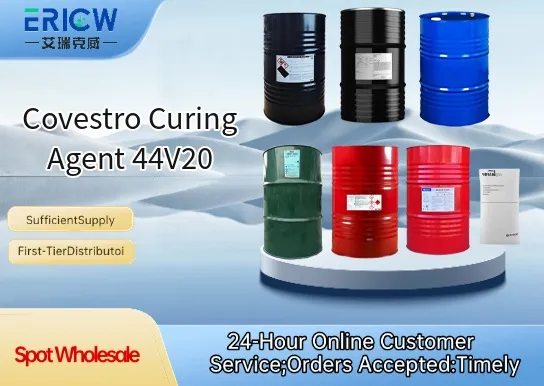
Q1: What is the primary function of Covestro Curing Agent 44V20 in coating and adhesive formulations?
A: Covestro Curing Agent 44V20 is a low-viscosity, aliphatic polyisocyanate designed to react with hydroxyl-functional resins (e.g., polyesters, acrylics, or polyethers) to form durable, crosslinked thermoset networks. It enables ambient- or low-bake cure profiles while delivering excellent gloss retention, weather resistance, and mechanical performance.
Q2: Is 44V20 suitable for high-solids or solvent-reduced systems?
A: Yes — its low viscosity and high NCO content make it well-suited for high-solids coatings and low-VOC formulations. It contributes to reduced solvent demand without compromising reactivity or film formation, supporting sustainability-focused formulation strategies.
Q3: How does 44V20 compare to aromatic curing agents in terms of yellowing resistance?
A: As an aliphatic isocyanate, 44V20 offers significantly superior UV stability and non-yellowing performance compared to aromatic alternatives (e.g., TDI or MDI derivatives), making it preferred for topcoats and clear finishes where long-term color stability is critical.
Q4: What storage conditions are recommended to maintain product stability?
A: Store in tightly sealed containers under dry, cool conditions (typically below 30 °C) and protect from moisture, heat, and direct sunlight. Prolonged exposure to humidity may lead to gelation or CO₂ evolution due to reaction with water.
Q5: Can 44V20 be used in two-component (2K) polyurethane systems for industrial maintenance coatings?
A: Yes — it is widely applied in 2K PU systems for industrial maintenance, automotive refinish, and plastic coatings, where balanced pot life, fast development of handling strength, and long-term chemical resistance are required.
Contact With Us:
E-mail: wangxingqiang@ericwchem.com
Have a Questions? Call Us:
Add:
Building A1, Jiete Industrial Park, Huangpu District, Guangzhou City, Guangdong Province, China