English
 Español
 tiếng việt
 русский
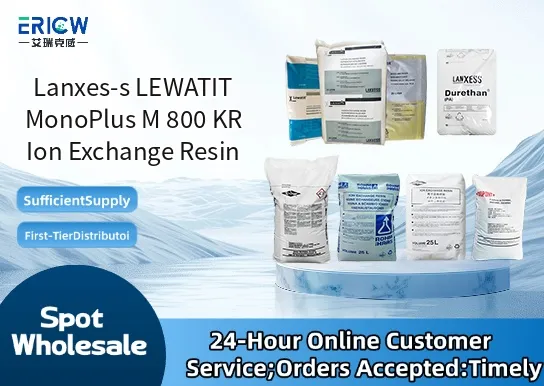
Highly uniform spherical beads ensuring consistent hydraulic performance and low pressure drop.
Optimized macroporous polystyrene-divinylbenzene matrix for superior chemical and physical stability.
Exceptional resistance to oxidation and osmotic shock, enabling extended service life in demanding cycles.
Designed for high selectivity toward potassium ions (K⁺) and other monovalent cations in complex matrices.
Low extractables profile, meeting stringent requirements for pharmaceutical and food-grade water polishing.
Final polishing of ultrapure water (UPW) in semiconductor manufacturing facilities.
Potassium removal from pharmaceutical process water and active pharmaceutical ingredient (API) synthesis streams.
Trace cation control in high-purity boiler feedwater systems for power generation.
Pre-treatment step for reverse osmosis (RO) and electrodeionization (EDI) systems requiring low ionic load.
| Chemical Type | Strong acid cation exchange resin (sulfonic acid functionalized) |
| Product Form | Moist, spherical beads |
| Appearance | Amber, transparent, gel-type beads with macroporous structure |
| Functional Group | –SO₃H (sulfonic acid) |
| Ionic Form | Hydrogen form (H⁺) |
| Particle Size Range | 0.45 – 1.25 mm |
| Uniformity Coefficient | ≤ 1.6 |
| Moisture Content | 47 – 53 % (w/w) |
Q1: What is the primary functional group and ionic form of LEWATIT MonoPlus M 800 KR?
A: LEWATIT MonoPlus M 800 KR is a strongly acidic cation exchange resin in the sodium form, featuring sulfonic acid functional groups grafted onto a highly crosslinked polystyrene-divinylbenzene matrix.
Q2: Is this resin suitable for use in food-grade or pharmaceutical water treatment applications?
A: Yes — LEWATIT MonoPlus M 800 KR is manufactured and tested to meet requirements for use in the production of potable water and process water in food and pharmaceutical industries, subject to proper regeneration and system validation per applicable regulatory guidelines.
Q3: How does the MonoPlus M 800 KR differ from standard gel-type cation resins?
A: The MonoPlus M 800 KR features a monodisperse bead size distribution and optimized physical structure, delivering improved hydraulic performance, higher resistance to osmotic shock, and more consistent service cycles compared to conventional gel-type cation resins.
Q4: What are typical regeneration requirements for this resin?
A: Regeneration is typically performed with sodium chloride solution. Optimal regenerant concentration, flow rate, and contact time depend on operating conditions including feed water quality, service cycle length, and desired effluent specifications — system-specific optimization is recommended.
Contact With Us:
E-mail: wangxingqiang@ericwchem.com
Have a Questions? Call Us:
Add:
Building A1, Jiete Industrial Park, Huangpu District, Guangzhou City, Guangdong Province, China