English
 Español
 tiếng việt
 русский
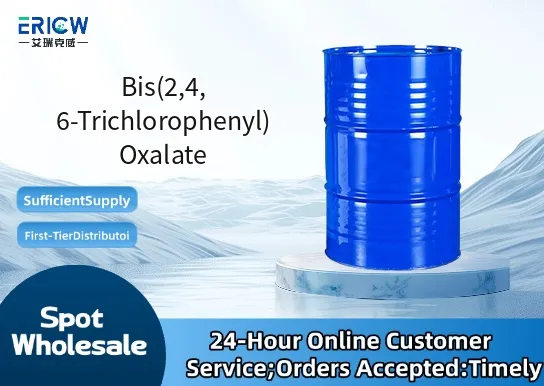
Highly efficient chemiluminescent activator with intense blue-green emission in non-aqueous systems.
Exceptional thermal and hydrolytic stability due to electron-withdrawing trichlorophenyl substituents.
Low volatility and high melting point ensure safe handling and extended shelf life under ambient conditions.
Consistent batch-to-batch performance validated by rigorous HPLC purity profiling (≥99.5% typical).
Non-hygroscopic crystalline solid enabling precise gravimetric dosing in industrial formulations.
Core component in solvent-based chemiluminescent emergency lighting devices (e.g., glow sticks, safety markers).
Key energy-transfer agent in forensic luminol enhancement kits for latent blood detection.
Stabilized activator in high-sensitivity analytical reagents for HPLC-CL and flow-injection chemiluminescence assays.
Performance enhancer in specialty polymer additives for light-emitting composites and security inks.
Reference standard in photometric calibration systems requiring reproducible, catalyst-free luminescence kinetics.
| Chemical Type | Aromatic oxalate ester |
| Product Form | Crystalline powder |
| Appearance | White to off-white free-flowing crystals |
| Melting Point | 128–132 °C (determined by DSC, 10 °C/min) |
| Purity (HPLC) | ≥99.5% (area %, single major peak) |
| Residue on Ignition | ≤0.1% (at 550 °C) |
| Moisture Content (KF) | ≤0.05% w/w |
| Regulatory Compliance | REACH registered; not classified under CLP for acute toxicity or environmental hazards |
| Common Compatible Systems | Suitability |
| Diethyl phthalate / dibutyl phthalate plasticizer blends | Highly Recommended – Excellent solubility (>25% w/w) and long-term solution stability at 25 °C |
| Hydrocarbon solvents (e.g., cyclohexane, xylene) | Recommended – Moderate solubility (8–12% w/w); requires gentle warming to 40 °C for full dissolution |
| Polycarbonate (PC) and ABS polymer matrices | Suitable – Compatible as dispersed phase up to 5 wt%; no adverse interfacial degradation observed |
| Aqueous buffer systems (pH 4–9) | Not Recommended – Rapid hydrolysis observed; use only in rigorously anhydrous environments |
Q1: What is the CAS Registry Number for Bis(2,4,6-Trichlorophenyl)Oxalate?
A: The CAS number is 77732-40-2. This identifier is verified against the Chemical Abstracts Service Master File and used for regulatory documentation and SDS referencing.
Q2: What is the recommended concentration range when formulating chemiluminescent devices?
A: Typical working concentrations range from 0.5% to 5.0% w/v in organic solvent carriers; optimal intensity and duration are achieved at 2.0–3.5% w/v with hydrogen peroxide catalyst and fluorescent dye co-activators.
Q3: How does it compare to TCPO (Bis(2,4,6-trichlorophenyl) oxalate) and CPPO in terms of performance and safety?
A: Bis(2,4,6-Trichlorophenyl)oxalate is chemically identical to TCPO — “TCPO” is the widely accepted industry synonym. It offers higher thermal stability and lower water sensitivity than CPPO (bis(2,4,5-trichlorophenyl)oxalate), with comparable quantum yield but improved formulation robustness.
Q4: Is migration or extraction into food simulants a concern for packaging-related applications?
A: Not applicable for direct food contact use. Bis(2,4,6-Trichlorophenyl)oxalate is not approved under FDA 21 CFR or EU Regulation (EC) No 10/2011 for food-contact materials due to lack of migration data and structural persistence; it is strictly intended for closed-system industrial and diagnostic applications.
Contact With Us:
E-mail: wangxingqiang@ericwchem.com
Have a Questions? Call Us:
Add:
Building A1, Jiete Industrial Park, Huangpu District, Guangzhou City, Guangdong Province, China