English
 Español
 tiếng việt
 русский
Exceptional low-temperature flexibility and impact resistance down to –60 °C
Outstanding melt processability with narrow molecular weight distribution
Excellent compatibility with polypropylene (PP) and polyethylene (PE) for blend modification
High elasticity and reversible deformation recovery under repeated stress
Good UV stability and long-term weathering resistance without added stabilizers
Automotive interior trim components requiring soft-touch feel and durability
Toughened polypropylene (PP) compounds for bumper fascia and under-hood parts
Flexible packaging films requiring seal integrity and puncture resistance
Footwear midsoles and sports equipment components demanding energy absorption
Wire and cable jacketing for enhanced flexibility and cold-weather performance
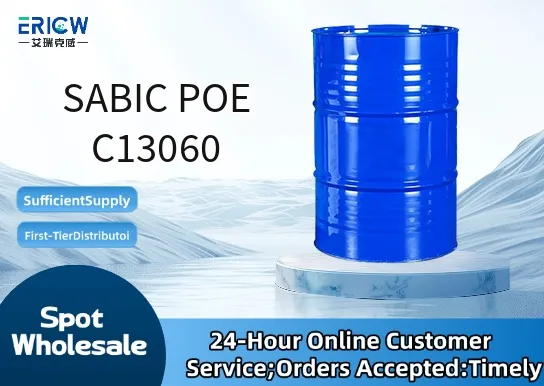
| Chemical Type | Polyolefin Elastomer (POE), ethylene-octene copolymer |
| Product Form | Natural-colored pellets |
| Appearance | Opaque, free-flowing cylindrical pellets |
| Primary Applications | PP/PE toughening, soft-touch overmolding, flexible film, elastomeric profiles |
| Key Features | Low density, high resilience, excellent clarity in thin sections |
| Benefits | Reduced part weight vs. TPEs, lower energy consumption during processing, recyclable in PE streams |
| Melt Flow Rate (190 °C/2.16 kg) | 0.5–1.5 g/10 min |
| Density (ASTM D792) | 0.865–0.875 g/cm³ |
Q1: What is the primary function of SABIC POE C13060 in polymer blends?
A: SABIC POE C13060 is an ethylene-octene copolymer designed primarily as a toughening agent and impact modifier—especially for rigid polyolefins such as PP and HDPE—enhancing low-temperature ductility, melt processability, and phase compatibility without significantly compromising stiffness.
Q2: Is SABIC POE C13060 suitable for food-contact applications?
A: SABIC POE C13060 is manufactured to meet general requirements for indirect food contact under applicable global regulatory frameworks; however, final compliance depends on the full formulation, processing conditions, and end-use scenario—users must conduct their own due diligence and validation per target market regulations.
Q3: How does SABIC POE C13060 differ from conventional EPDM or EPR impact modifiers?
A: Unlike traditional diene-based elastomers, SABIC POE C13060 offers superior thermal stability, narrower molecular weight distribution, and excellent dispersion in polyolefin matrices—resulting in more consistent mechanical performance and reduced risk of gel formation during high-shear compounding.
Q4: What are typical processing recommendations for SABIC POE C13060?
A: SABIC POE C13060 processes readily using standard polyolefin equipment—including twin-screw extruders and injection molding machines—with recommended melt temperatures generally ranging from 180 °C to 230 °C; drying is typically not required unless material has been exposed to prolonged ambient humidity.
Q5: Can SABIC POE C13060 be used in blow-molded or thermoformed applications?
A: Yes—its balanced melt strength and extensional rheology make it well-suited for improving parison stability in blow molding and enhancing draw-down behavior in thermoforming, particularly when blended with PP or HDPE base resins.
Contact With Us:
E-mail: wangxingqiang@ericwchem.com
Have a Questions? Call Us:
Add:
Building A1, Jiete Industrial Park, Huangpu District, Guangzhou City, Guangdong Province, China