English
 Español
 tiếng việt
 русский
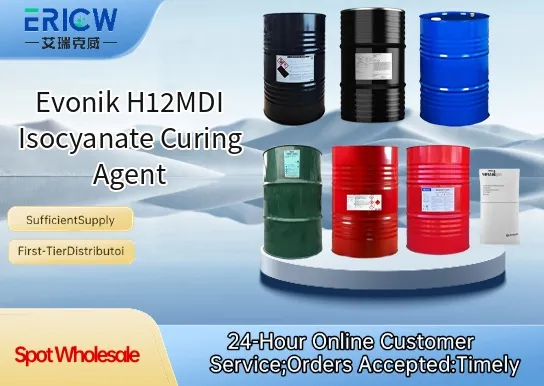
Exceptional hydrolytic stability due to fully saturated cyclohexane ring structure.
Low volatility and reduced vapor pressure compared to aromatic isocyanates, enhancing workplace safety.
Excellent compatibility with polyols and polyester/polyether resins for high-performance coatings and adhesives.
Enables production of light-stable, non-yellowing polyurethane systems ideal for demanding aesthetic applications.
Consistent reactivity profile suitable for precise process control in industrial two-component formulations.
High-end automotive clearcoats and OEM refinish coatings.
Architectural and industrial maintenance coatings requiring long-term color retention.
Optical-grade adhesives for laminated glass and display assemblies.
Precision elastomers for medical devices and food-contact compliant components.
UV-resistant polyurethane sealants and joint fillers for façade and infrastructure projects.
| Chemical Type | Aliphatic diisocyanate (4,4'-dicyclohexylmethane diisocyanate, hydrogenated MDI) |
| Product Form | Liquid |
| Appearance | Colorless to pale yellow transparent liquid |
| NCO Content (wt%) | Approx. 33.5–34.2% |
| Viscosity at 25°C (mPa·s) | 80–120 |
| Specific Gravity (20°C) | 1.12–1.15 |
| Storage Stability | Stable under dry, inert atmosphere at <25°C; protect from moisture |
| Key Features | Aliphatic, non-yellowing, low volatility, high hydrolytic resistance |
Q1: What distinguishes H12MDI from aromatic isocyanates like TDI or MDI in terms of performance?
A: H12MDI is a saturated aliphatic isocyanate offering superior UV stability and hydrolytic resistance compared to aromatic alternatives. This makes it ideal for applications requiring long-term color retention, outdoor exposure, or resistance to yellowing—such as high-performance coatings, optical adhesives, and transparent elastomers.
Q2: How should H12MDI be handled and stored to maintain reactivity and shelf life?
A: H12MDI should be stored under dry, inert conditions (e.g., nitrogen blanket) at temperatures between 15–25 °C, protected from moisture, heat, and direct sunlight. Exposure to ambient humidity may cause premature dimerization or gelation; therefore, strict moisture control during handling—using dried equipment and closed systems—is essential.
Q3: Is H12MDI compatible with common polyol systems used in polyurethane formulations?
A: Yes—H12MDI exhibits broad compatibility with polyester, polyether, polycarbonate, and acrylic polyols. Its symmetrical structure and moderate reactivity support controlled processing and good pot life, especially when formulated with appropriate catalysts and stabilizers.
Q4: Can H12MDI-based systems meet low-VOC and regulatory requirements for industrial coatings?
A: H12MDI has inherently low volatility and can be formulated into high-solids or solvent-free systems. When combined with low-VOC polyols and optimized processing, it supports compliance with evolving environmental regulations—including regional VOC limits and sustainability targets—without compromising film performance.
Contact With Us:
E-mail: wangxingqiang@ericwchem.com
Have a Questions? Call Us:
Add:
Building A1, Jiete Industrial Park, Huangpu District, Guangzhou City, Guangdong Province, China