English
 Español
 tiếng việt
 русский
High chemical resistance to solvents, acids, and alkalis.
Excellent weathering and UV stability for long-term outdoor performance.
Low viscosity enabling easy processing and high solids formulation.
Good flexibility and impact resistance without compromising hardness.
Compatible with melamine-formaldehyde and urea-formaldehyde crosslinkers.
Automotive OEM and refinish coatings.
Industrial coil and can coatings.
Architectural and appliance powder coatings.
High-performance wood and metal decorative finishes.
Crosslinked thermoset systems requiring durability and gloss retention.
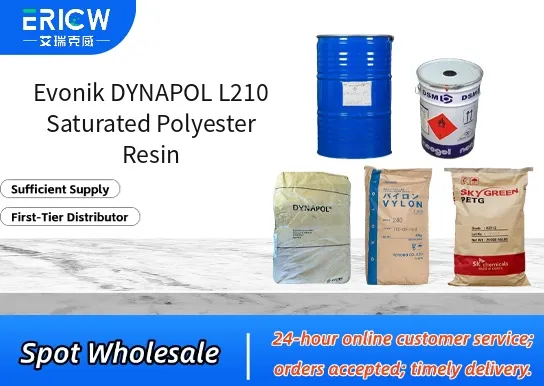
| Chemical Type | Saturated polyester resin |
| Product Form | Pale yellow to light amber viscous liquid |
| Appearance | Clear, homogeneous liquid |
| Primary Applications | Powder coatings, coil coatings, automotive topcoats |
| Key Features | High crosslink density, low VOC, excellent film formation |
| Benefits | Enhanced mechanical properties, superior gloss and smoothness |
| Storage Stability | Stable at 20–25 °C for ≥12 months in sealed containers |
| Crosslinker Compatibility | Standard melamine resins (e.g., hexamethoxymethylmelamine) |
Q1: What is the primary function of DYNAPOL L210 in powder coating formulations?
A: DYNAPOL L210 serves as a reactive binder resin that provides excellent flow, leveling, and mechanical durability in thermosetting polyester-based powder coatings. It is specifically designed for use with triglycidyl isocyanurate (TGIC) or hydroxyalkyl amide (HAA) curing agents to form high-performance, weather-resistant coatings.
Q2: Is DYNAPOL L210 suitable for outdoor applications?
A: Yes — DYNAPOL L210 delivers strong UV resistance and long-term gloss retention when formulated with appropriate curing agents and stabilizers, making it well-suited for exterior architectural and industrial applications requiring high weathering performance.
Q3: How does DYNAPOL L210 differ from standard unsaturated polyester resins?
A: Unlike unsaturated polyesters, DYNAPOL L210 is fully saturated, eliminating reactive double bonds that can lead to premature gelation or reduced storage stability. This saturation enhances thermal stability during extrusion and improves shelf life in powder form.
Q4: Can DYNAPOL L210 be used in low-cure or energy-efficient powder coating systems?
A: Yes — its molecular design supports good reactivity at reduced cure temperatures (e.g., 160–180 °C), especially when paired with optimized HAA-type hardeners, enabling energy-saving processing without compromising film integrity or crosslink density.
Contact With Us:
E-mail: wangxingqiang@ericwchem.com
Have a Questions? Call Us:
Add:
Building A1, Jiete Industrial Park, Huangpu District, Guangzhou City, Guangdong Province, China