English
 Español
 tiếng việt
 русский
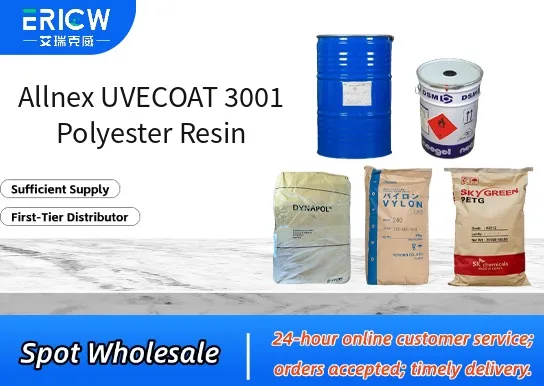
High reactivity in UV-curable systems for rapid through-cure and excellent surface hardness.
Low viscosity enables easy formulation with high monomer compatibility and reduced VOC content.
Excellent chemical resistance post-cure, including resistance to alcohols, cleaning agents, and mild acids.
Superior adhesion to diverse substrates such as plastics, metals, and coated wood.
Good weathering stability with enhanced UV resistance for indoor and semi-outdoor applications.
UV-curable coatings for plastic packaging and cosmetic containers.
Decorative and protective topcoats for automotive interior trim.
Functional coatings on electronic device housings and consumer electronics.
High-gloss finishes for premium furniture and MDF board laminates.
Overprint varnishes for flexible packaging films requiring abrasion resistance.
| Chemical Type | Aliphatic polyester acrylate |
| Product Form | Liquid resin |
| Appearance | Clear, pale yellow liquid |
| Viscosity (25 °C, mPa·s) | 800–1,200 |
| Acid Value (mg KOH/g) | ≤ 5 |
| Refractive Index (25 °C) | 1.47–1.49 |
| Primary Applications | UV-curable protective and decorative coatings |
| Key Features | Fast cure, low shrinkage, high crosslink density |
Q1: What is the primary function of UVECOAT 3001 in UV-curable formulations?
A: UVECOAT 3001 is a low-viscosity, aliphatic polyester acrylate resin designed to serve as a reactive diluent and film-forming binder in UV-curable coatings. It contributes flexibility, good adhesion to various substrates, and balanced cure speed without excessive shrinkage.
Q2: Is UVECOAT 3001 suitable for food-contact or packaging applications?
A: UVECOAT 3001 is formulated for use in industrial and decorative UV coatings. While it may be incorporated into systems intended for indirect food contact, final regulatory compliance depends on the complete formulation, processing conditions, and applicable regional regulations — end users must conduct full migration and safety assessments.
Q3: How does UVECOAT 3001 compare to epoxy acrylates in terms of flexibility and yellowing resistance?
A: Unlike rigid epoxy acrylates, UVECOAT 3001 offers superior flexibility and impact resistance due to its aliphatic polyester backbone. Its aliphatic structure also provides excellent resistance to yellowing upon UV exposure, making it well-suited for clear coats and white or pastel-colored systems requiring long-term color stability.
Q4: What types of photoinitiators are typically recommended for use with UVECOAT 3001?
A: UVECOAT 3001 performs well with common Type I (cleavage-type) and Type II (hydrogen-abstraction-type) photoinitiators, including alpha-hydroxy ketones and benzophenone derivatives. Selection should consider substrate sensitivity, cure depth requirements, and regulatory constraints — compatibility testing is recommended for each specific formulation.
Contact With Us:
E-mail: wangxingqiang@ericwchem.com
Have a Questions? Call Us:
Add:
Building A1, Jiete Industrial Park, Huangpu District, Guangzhou City, Guangdong Province, China