English
 Español
 tiếng việt
 русский
Excellent film clarity and gloss retention after curing.
Low VOC content (< 50 g/L), compliant with stringent environmental regulations.
Good hydrolytic stability and resistance to yellowing under UV exposure.
Compatible with common waterborne acrylics and crosslinkers for hybrid formulations.
Smooth, non-tacky dry film with balanced hardness and flexibility.
High-performance waterborne wood coatings for furniture and flooring.
Automotive interior trim coatings requiring low odor and abrasion resistance.
Eco-friendly leather finishing topcoats for footwear and upholstery.
Industrial maintenance coatings for metal substrates in mild-corrosion environments.
Water-based overprint varnishes for flexible packaging and paperboard.
| Chemical Type | Aliphatic waterborne polyurethane dispersion |
| Product Form | Aqueous dispersion |
| Appearance | Translucent, slightly bluish milky liquid |
| Solids Content | 30.0 ± 1.0 wt% |
| pH Value | 7.8 – 8.5 |
| Viscosity (Brookfield, RVT #2, 25°C) | 80 – 150 mPa·s |
| Particle Size (D50) | 80 – 120 nm |
| Minimum Film Formation Temperature (MFFT) | 12 – 15°C |
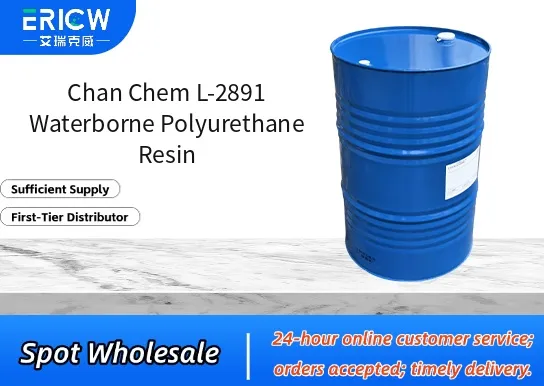
Q1: What are the primary application areas for Chan Chem L-2891?
A: Chan Chem L-2891 is widely used in high-performance waterborne coatings for flexible substrates, including synthetic leather finishing, textile coatings, and soft-touch decorative films. Its excellent film-forming ability and low-temperature coalescence make it particularly suitable for heat-sensitive materials.
Q2: How does L-2891 compare to solvent-based polyurethane resins in terms of film properties?
A: L-2891 delivers comparable mechanical performance—including abrasion resistance, flexibility, and tensile strength—to many solvent-based alternatives, while offering significantly lower VOC content and improved workplace safety. Film hardness and elasticity can be fine-tuned via formulation adjustments, such as crosslinker selection or blending with acrylic dispersions.
Q3: Is L-2891 compatible with common additives and crosslinkers?
A: Yes—L-2891 demonstrates good compatibility with standard waterborne additives (e.g., defoamers, wetting agents, rheology modifiers) and commonly used blocked isocyanate or aziridine crosslinkers. Compatibility should always be verified experimentally within the final formulation due to sensitivity to pH, ionic strength, and shear history.
Q4: What are the recommended storage conditions and shelf life?
A: Store L-2891 in tightly sealed containers at temperatures between 5 °C and 35 °C, away from direct sunlight and freezing conditions. Under proper storage, the typical shelf life is 12 months from the date of manufacture. Prolonged exposure to elevated temperatures or repeated freeze-thaw cycles may affect stability and viscosity.
Contact With Us:
E-mail: wangxingqiang@ericwchem.com
Have a Questions? Call Us:
Add:
Building A1, Jiete Industrial Park, Huangpu District, Guangzhou City, Guangdong Province, China