English
 Español
 tiếng việt
 русский
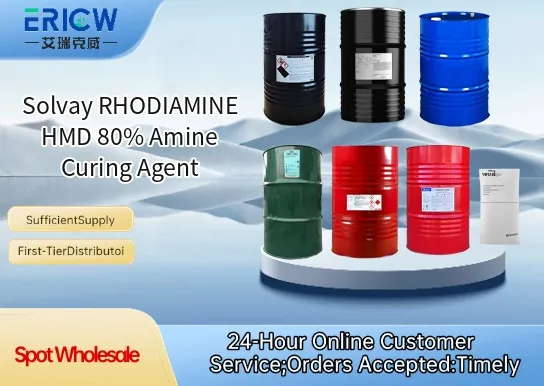
High reactivity with epoxy resins enabling rapid cure at ambient or elevated temperatures.
Excellent chemical resistance and thermal stability in cured epoxy networks.
Low viscosity liquid formulation facilitates easy handling, metering, and homogeneous mixing.
Consistent 80% active amine content ensures predictable stoichiometry and reproducible performance.
Low volatility and favorable occupational hygiene profile compared to traditional aliphatic amines.
Structural adhesives for aerospace and automotive bonding.
High-performance composite matrices in wind turbine blades and industrial laminates.
Electrical encapsulants and potting compounds requiring low exotherm and high Tg.
Coatings for corrosion protection in marine and infrastructure applications.
Tooling and casting resins demanding dimensional stability and mechanical toughness.
| Chemical Type | Aliphatic diamine (hexamethylenediamine derivative) |
| Product Form | Liquid |
| Appearance | Clear, pale yellow liquid |
| Amine Value | 450–470 mg KOH/g |
| Active Amine Content | ~80 wt% |
| Density (20°C) | 0.91–0.93 g/cm³ |
| Viscosity (25°C) | 15–25 mPa·s |
| Primary Applications | Epoxy resin curing for structural composites, adhesives, and protective coatings |
Q1: What is the primary function of RHODIAMINE HMD 80% in epoxy systems?
A: RHODIAMINE HMD 80% serves as a highly reactive aliphatic amine curing agent for epoxy resins, enabling rapid ambient- or elevated-temperature cure with excellent mechanical properties, chemical resistance, and low viscosity for easy handling and formulation.
Q2: Is RHODIAMINE HMD 80% compatible with standard bisphenol-A and bisphenol-F epoxy resins?
A: Yes — it demonstrates broad compatibility with common liquid and solid epoxy resins, including DGEBA and DGEBF types, and is frequently selected for high-performance coatings, adhesives, and composite matrices requiring fast turnaround and good through-cure.
Q3: How does the 80% active content affect formulation and handling?
A: The 80% concentration reflects the active amine content in a low-viscosity solvent carrier, which improves processability and shelf stability while allowing precise stoichiometric adjustment. Formulators typically account for the diluent when calculating equivalent ratios and optimizing pot life versus cure speed.
Q4: What safety and handling precautions are recommended?
A: As with all aliphatic amines, RHODIAMINE HMD 80% is corrosive and may cause skin and respiratory sensitization. Use appropriate PPE (gloves, goggles, ventilation), avoid prolonged or repeated exposure, and consult the Safety Data Sheet (SDS) for detailed occupational hygiene guidance and first-aid measures.
Q5: Can RHODIAMINE HMD 80% be used in applications requiring low VOC or regulatory compliance?
A: It contains a low-boiling, volatile organic carrier; therefore, formulations should be evaluated for VOC content and emissions profile per regional requirements. For low-VOC alternatives, Solvay offers other amine technologies — contact technical support to explore suitable options aligned with your sustainability and compliance goals.
Contact With Us:
E-mail: wangxingqiang@ericwchem.com
Have a Questions? Call Us:
Add:
Building A1, Jiete Industrial Park, Huangpu District, Guangzhou City, Guangdong Province, China