English
 Español
 tiếng việt
 русский
High reactivity with hydroxyl and amine functional groups for rapid room-temperature or low-bake curing.
Excellent chemical resistance and hydrolytic stability in demanding industrial coatings.
Low volatility and favorable toxicological profile compared to conventional aliphatic isocyanates.
Enhanced UV stability and yellowing resistance — ideal for high-gloss, light-stable topcoats.
Good compatibility with acrylic, polyester, and polyol resin systems without phase separation.
Automotive OEM clearcoats and basecoats requiring high durability and gloss retention.
Industrial maintenance coatings for metal substrates exposed to harsh environments.
High-performance plastic coatings (e.g., automotive interior trim, electronics housings).
UV-resistant architectural coatings for aluminum composite panels and façade systems.
Two-component (2K) polyurethane wood finishes demanding low VOC and fast handling strength.
| Chemical Type | Aliphatic isocyanate crosslinker based on isophorone diisocyanate (IPDI) |
| Product Form | Liquid |
| Appearance | Clear, colorless to pale yellow liquid |
| Primary Applications | 2K polyurethane coatings, automotive refinish, industrial maintenance, plastic coatings |
| Key Features | Low viscosity, excellent storage stability, non-yellowing, high functionality |
| Benefits | Improved pot life control, reduced VOC emissions, enhanced film hardness and flexibility balance |
| Storage Conditions | Store under dry nitrogen, at 15–25 °C, protected from moisture |
| Handling Precautions | Use in well-ventilated areas; avoid contact with water, alcohols, or amines prior to formulation |
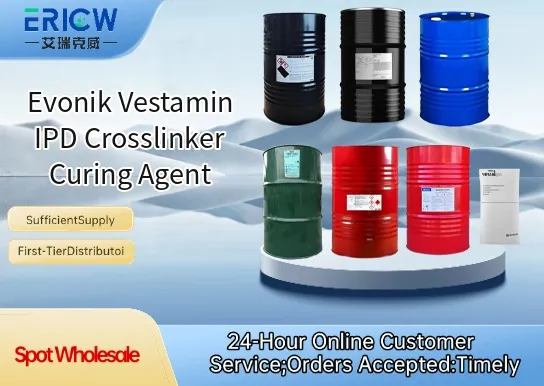
Q1: What is the primary chemical nature of Vestamin IPD?
A: Vestamin IPD is a cycloaliphatic diamine based on isophoronediamine (IPDA), offering high reactivity, low volatility, and excellent compatibility with various epoxy resins and polyurethane systems.
Q2: How does Vestamin IPD compare to aromatic amines in terms of yellowing and UV stability?
A: Unlike aromatic amines, Vestamin IPD is non-yellowing and provides significantly improved UV resistance and color retention in cured coatings and adhesives, making it suitable for applications where long-term clarity or light-colored finishes are required.
Q3: What types of resin systems is Vestamin IPD commonly used with?
A: It is widely employed as a curing agent for epoxy resins—especially in high-performance coatings, composites, and electrical encapsulants—and also functions effectively in certain polyurethane and polyurea formulations requiring enhanced flexibility and chemical resistance.
Q4: Is special handling or storage required for Vestamin IPD?
A: Yes—Vestamin IPD is moisture-sensitive and should be stored under dry, inert conditions (e.g., nitrogen blanket) in tightly sealed containers. Prolonged exposure to ambient humidity may lead to gelation or reduced reactivity, so good manufacturing practices for amine handling are recommended.
Q5: How does the cure speed of Vestamin IPD compare to other aliphatic diamines?
A: Vestamin IPD offers faster reactivity than many linear aliphatic diamines due to its sterically hindered yet nucleophilic cycloaliphatic structure, enabling shorter pot life and accelerated ambient- or low-temperature cure profiles without sacrificing final mechanical properties.
Contact With Us:
E-mail: wangxingqiang@ericwchem.com
Have a Questions? Call Us:
Add:
Building A1, Jiete Industrial Park, Huangpu District, Guangzhou City, Guangdong Province, China