English
 Español
 tiếng việt
 русский
High chroma and excellent color strength for vivid, consistent hue reproduction.
Outstanding thermal stability suitable for high-temperature processing up to 280 °C.
Good lightfastness and weather resistance in outdoor applications.
Excellent dispersibility in both polar and non-polar polymer matrices.
Low volatility and minimal extractables—compliant with stringent food-contact and toy safety requirements.
Coloration of polyolefins (PP, PE) for automotive interior components.
Masterbatch formulation for rigid PVC profiles and window frames.
Pigmenting engineering plastics including ABS and PC for consumer electronics housings.
Food-safe packaging films requiring FDA-compliant colorants.
Toy-grade polypropylene parts meeting EN71-3 and ASTM F963 heavy metal limits.
| Chemical Type | Organic pigment (Benzimidazolone derivative) |
| Product Form | Free-flowing granular powder |
| Appearance | Reddish-brown free-flowing granules |
| Primary Applications | Polyolefins, PVC, ABS, PC, TPE |
| Key Features | Thermally stable, low migration, high dispersion efficiency |
| Benefits | Consistent batch-to-batch color, reduced filter pressure buildup, improved melt flow |
| Regulatory Compliance | EU REACH registered; compliant with FDA 21 CFR §178.3297 and EU Plastics Regulation (EU) No 10/2011 |
| Storage Conditions | Store in cool, dry place below 30 °C; protect from moisture and direct sunlight |
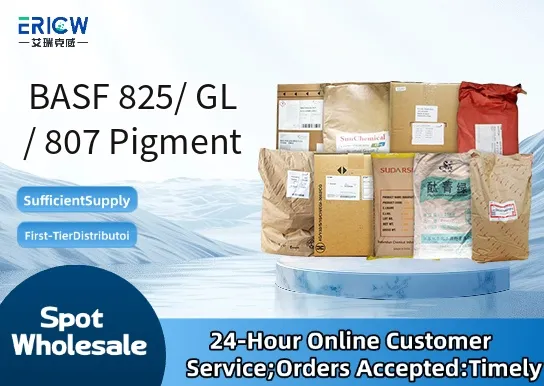
Q1: What is the primary chemical nature of BASF 825/ GL/ 807 Pigment?
A: BASF 825/ GL/ 807 is an organic pigment dispersion formulated for high-performance applications, based on a chemically stabilized azo or condensed azo-type chromophore system. It is supplied as a ready-to-use liquid dispersion in a non-aqueous vehicle optimized for compatibility with common polymer and coating resins.
Q2: Is this pigment suitable for food-contact plastics or packaging applications?
A: BASF 825/ GL/ 807 is not pre-qualified for direct food-contact applications. Its use in such systems requires full regulatory assessment by the formulator, including evaluation of migration behavior, thermal stability during processing, and compliance with applicable regional food-contact legislation. It is commonly selected for non-food industrial coatings and technical plastics where high chroma and weather resistance are prioritized.
Q3: What types of polymers or resin systems show good compatibility with this pigment?
A: This pigment demonstrates excellent compatibility with thermoplastic polymers such as polyolefins (PP, PE), polystyrene, ABS, and engineering plastics like PA6 and PC—particularly when processed via injection molding or extrusion. It is also widely used in solvent-borne and high-solids industrial coatings based on acrylics, alkyds, and polyurethanes.
Q4: How should BASF 825/ GL/ 807 be incorporated into a formulation?
A: It is designed for direct addition to molten polymer or liquid resin systems without pre-drying or pre-mixing steps. For optimal dispersion, incorporate during the early melt phase under moderate shear. Dosage typically ranges from 0.1% to 2% by weight, depending on the required color strength and substrate opacity requirements.
Q5: Does this pigment offer good resistance to heat, light, and weathering?
A: Yes — BASF 825/ GL/ 807 is engineered for enhanced thermal stability (suitable for processing up to typical polyolefin extrusion temperatures) and delivers good to very good lightfastness and weather resistance in outdoor applications, especially when protected within a UV-stabilized matrix.
Contact With Us:
E-mail: wangxingqiang@ericwchem.com
Have a Questions? Call Us:
Add:
Building A1, Jiete Industrial Park, Huangpu District, Guangzhou City, Guangdong Province, China