English
 Español
 tiếng việt
 русский
Exceptional resistance to aggressive chemicals including fuels, lubricants, and aromatic hydrocarbons.
High thermal stability with continuous service capability up to 200 °C.
Low compression set retention for reliable sealing performance under prolonged stress.
Excellent adhesion to various substrates without primer in many bonding applications.
Platinum-cured system offering rapid, consistent, and residue-free vulcanization.
Aerospace fluid-handling seals and gaskets exposed to jet fuels and hydraulic fluids.
Automotive fuel system components including injector O-rings and fuel rail seals.
Industrial valves and pump diaphragms operating in chemically demanding environments.
Oil & gas downhole instrumentation seals requiring H₂S and sour gas resistance.
| Chemical Type | Fluoro liquid silicone rubber (FLSR) |
| Product Form | Two-part, platinum-catalyzed liquid elastomer system |
| Appearance | Opaque, viscous liquid (Part A); translucent, low-viscosity liquid (Part B) |
| Primary Applications | Static and dynamic seals, gaskets, and molded fluid-contact components |
| Key Features | Fluorosilicone chemistry with enhanced hydrocarbon resistance |
| Benefits | Extended service life in aggressive chemical environments vs. standard LSR |
| Curing System | Pt-catalyzed addition cure (no by-products) |
| Shore A Hardness (Cured) | 70 ± 3 |
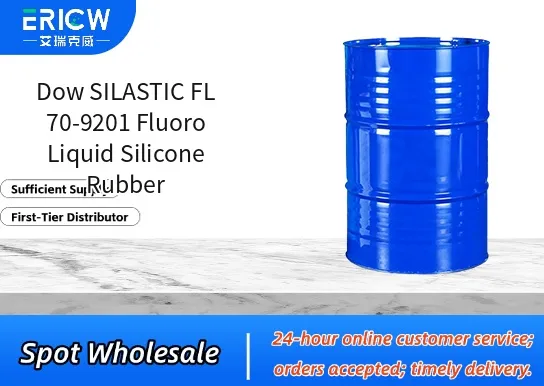
Q1: What are the key performance advantages of Dow SILASTIC FL 70-9201 compared to standard liquid silicone rubbers?
A: Dow SILASTIC FL 70-9201 offers enhanced resistance to aggressive chemicals—including fuels, oils, and polar solvents—due to its fluorinated backbone. It also maintains superior thermal stability and low compression set at elevated temperatures, making it suitable for demanding sealing and gasketing applications where conventional LSRs may degrade.
Q2: Is FL 70-9201 compatible with standard platinum-cure LSR processing equipment and tooling?
A: Yes, FL 70-9201 is formulated for compatibility with conventional liquid injection molding (LIM) systems used for platinum-cured silicones. It exhibits appropriate viscosity, pot life, and cure kinetics for high-volume production—though optimal processing parameters (e.g., mold temperature, injection speed, and post-cure time) should be validated for each specific part geometry and equipment setup.
Q3: Can FL 70-9201 be overmolded onto thermoplastics or other elastomers?
A: FL 70-9201 can be successfully overmolded onto many engineering thermoplastics (e.g., PBT, PPA, and certain polyamides) and some thermoplastic elastomers, provided proper surface preparation, mold design, and thermal management are applied. Adhesion is typically achieved through mechanical interlock and controlled interfacial diffusion rather than covalent bonding—bond strength should be confirmed via application-specific testing.
Q4: Does FL 70-9201 require a post-cure step, and if so, what is its purpose?
A: A post-cure is recommended to fully develop optimal physical properties—particularly chemical resistance, thermal stability, and long-term compression set performance. While the material achieves handling strength after primary cure, elevated-temperature post-curing helps complete crosslinking and volatilize residual byproducts, ensuring consistent performance in critical service environments.
Contact With Us:
E-mail: wangxingqiang@ericwchem.com
Have a Questions? Call Us:
Add:
Building A1, Jiete Industrial Park, Huangpu District, Guangzhou City, Guangdong Province, China