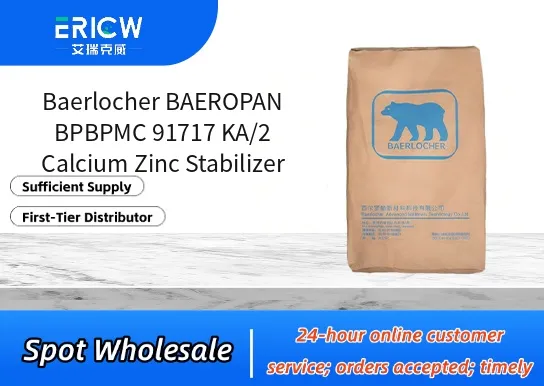
Non-toxic, heavy-metal-free formulation compliant with global food-contact and toy safety regulations (EU Plastics Regulation (EU) No 10/2011, EN 71-3, RoHS).
Excellent long-term thermal stability for rigid and flexible PVC processing, minimizing color development during extrusion and calendering.
Good compatibility with common PVC plasticizers (e.g., DOP, DOTP) and co-stabilizers, enabling balanced performance in complex compound systems.
Enhanced initial color hold and low volatility, supporting high-output production without plate-out or die buildup.
Optimized calcium/zinc synergy delivering balanced lubricity, melt homogeneity, and fusion control in both dry-blend and hot-mix applications.
Rigid PVC profiles for window frames, door systems, and cladding.
PVC pipes and fittings for potable water and drainage applications.
Flexible PVC flooring, wall coverings, and coated fabrics.
Medical tubing and packaging films requiring non-toxic, phthalate-compatible stabilization.
Children’s toys and childcare articles meeting stringent migration limits.
| Chemical Type | Calcium zinc carboxylate-based liquid stabilizer |
| Product Form | Clear to pale yellow viscous liquid |
| Appearance | Homogeneous, free from sediment or phase separation |
| Primary Applications | Rigid and flexible PVC compounds |
| Key Features | Heavy-metal-free, low-volatility, high thermal stability |
| Benefits | Regulatory compliance, consistent color retention, reduced plate-out |
| Storage Stability | Stable for ≥12 months at 5–30 °C in sealed containers |
| Compatibility | Compatible with common PVC resins, plasticizers (DOP, DOTP), and processing aids |
Q1: What is the primary application of BAEROPAN BPBPMC 91717 KA/2?
A: This calcium zinc stabilizer is specifically formulated for rigid and semi-rigid PVC applications, including pipes, profiles, sheets, and technical injection-molded parts where long-term thermal stability and low-temperature impact resistance are required.
Q2: Is BAEROPAN BPBPMC 91717 KA/2 suitable for food-contact or potable water applications?
A: Yes — it is designed to meet regulatory expectations for indirect food contact and drinking water systems in multiple global markets, leveraging non-toxic calcium and zinc components without heavy metals such as lead or cadmium.
Q3: How does this stabilizer perform under high-shear processing conditions?
A: BAEROPAN BPBPMC 91717 KA/2 demonstrates excellent melt stability and consistent performance during extrusion and injection molding, minimizing plate-out and maintaining color hold across extended processing cycles.
Q4: What is the typical dosage range for this stabilizer in PVC formulations?
A: Dosage depends on formulation requirements and processing conditions, but it is generally used at low concentrations — typically ranging from 0.1% to 2% by weight relative to PVC resin.
Q5: Can BAEROPAN BPBPMC 91717 KA/2 be combined with other additives like lubricants or impact modifiers?
A: Yes — it is fully compatible with standard PVC additive packages, including internal/external lubricants, impact modifiers, and fillers, and is designed to support balanced formulation development without adverse interactions.
Contact With Us:
E-mail: wangxingqiang@ericwchem.com
Have a Questions? Call Us:
Add:
Building A1, Jiete Industrial Park, Huangpu District, Guangzhou City, Guangdong Province, China
 English
 Español
 tiếng việt
 русский