English
 Español
 tiếng việt
 русский
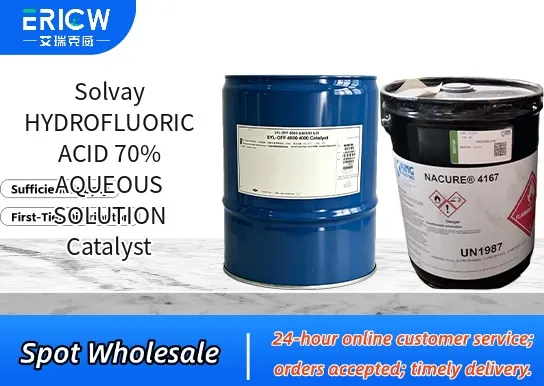
High-purity 70% aqueous hydrofluoric acid formulated for consistent catalytic performance in industrial fluorination processes.
Manufactured under strict Solvay quality control protocols to ensure batch-to-batch reproducibility and low metal impurity levels.
Optimized for enhanced stability and handling safety in continuous-flow reactor systems requiring precise HF dosing.
Compatible with standard fluoropolymer-lined and Hastelloy®-constructed process equipment.
Supplied with comprehensive SDS, traceability documentation, and technical support for catalyst integration.
Catalytic alkylation in high-octane gasoline production (e.g., isobutane–butene alkylation).
Fluorination of organic intermediates for pharmaceutical and agrochemical synthesis.
Production of fluorinated refrigerants and fluorochemical building blocks.
Surface etching and cleaning of silicon wafers and specialty glass in semiconductor manufacturing.
Preparation of aluminum fluoride and other metal fluorides for aluminum smelting applications.
| Chemical Type | Hydrofluoric acid (HF) aqueous solution |
| Product Form | Liquid |
| Appearance | Clear, colorless to pale yellow liquid |
| HF Concentration (w/w %) | 69.5–70.5% |
| Impurity: Sulfuric Acid (H₂SO₄) | < 0.01% |
| Impurity: Iron (Fe) | < 1 ppm |
| Impurity: Chloride (Cl⁻) | < 5 ppm |
| Primary Applications | Catalyst in alkylation, fluorination, and etching processes |
Q1: What is the primary catalytic function of this 70% aqueous hydrofluoric acid solution in industrial processes?
A: This concentrated aqueous HF solution serves primarily as a strong Brønsted acid catalyst in alkylation, isomerization, and fluorination reactions—especially in petrochemical refining and specialty fluorochemical synthesis—where high proton availability and fluoride ion reactivity are required.
Q2: How does the 70% concentration balance reactivity, handling safety, and process efficiency compared to other HF grades?
A: The 70% w/w aqueous formulation offers an optimized compromise: higher acidity and fluoride activity than diluted grades (e.g., 49%), while reducing volatility and fuming tendency relative to anhydrous or >75% HF—supporting safer containment and more controllable dosing in continuous catalytic systems.
Q3: Is this product suitable for use in stainless steel reactors, or what material compatibility considerations apply?
A: Standard austenitic stainless steels (e.g., 304, 316) are not resistant to 70% HF and will suffer rapid corrosion. Compatible equipment typically employs specialized alloys such as Monel® 400 or Hastelloy® C-276, or lined systems with fluoropolymer coatings—material selection must be validated under actual process conditions including temperature and flow regime.
Q4: What key handling precautions are essential when using this catalyst in production environments?
A: Strict adherence to HF-specific safety protocols is mandatory—including full-face respirators with HF-rated cartridges, calcium gluconate gel on-site, chemical-resistant gloves (e.g., butyl rubber), and engineered ventilation. Due to HF’s unique dermal penetration and systemic toxicity, all personnel must undergo specialized HF emergency response training prior to handling.
Contact With Us:
E-mail: wangxingqiang@ericwchem.com
Have a Questions? Call Us:
Add:
Building A1, Jiete Industrial Park, Huangpu District, Guangzhou City, Guangdong Province, China