English
 Español
 tiếng việt
 русский
Excellent elasticity and resilience for repeated compression cycling
Good processability via injection molding and extrusion without pre-drying
Soft-touch surface with low coefficient of friction and high abrasion resistance
RoHS-compliant formulation with no phthalates, heavy metals, or halogenated flame retardants
Wide service temperature range from −40 °C to +80 °C
Overmolding for consumer electronics housings and grips
Sealing components in automotive interior trim and fluid handling systems
Flexible grips for hand tools and medical device handles
Soft-touch buttons and tactile interfaces in industrial control panels
Non-slip mats and ergonomic accessories for office and home use
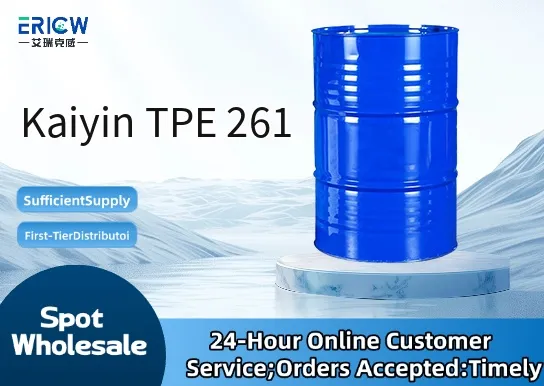
| Chemical Type | Thermoplastic Elastomer (SEBS-based) |
| Product Form | Pellets |
| Appearance | Translucent to slightly opaque, uniform granules |
| Hardness (Shore A) | 65 ± 3 |
| Density (g/cm³) | 0.92–0.94 |
| Melt Flow Rate (230 °C/2.16 kg) | 15–22 g/10 min |
| Primary Applications | Overmolding, soft-touch components, sealing elements |
| Key Features | Elastic recovery, processing ease, skin-friendly surface |
Q1: What is Kaiyin TPE 261 primarily used for?
A: Kaiyin TPE 261 is a thermoplastic elastomer modifier designed to enhance flexibility, impact resistance, and melt processability in rigid polymer blends—especially in polypropylene (PP) and polyethylene (PE)-based systems for automotive interior parts, consumer appliance housings, and soft-touch overmolding applications.
Q2: Is Kaiyin TPE 261 compatible with common processing methods?
A: Yes—it is fully compatible with standard thermoplastic processing techniques including injection molding, extrusion, and two-shot molding. Its thermal stability and low melt viscosity support consistent flow and good interfacial adhesion in multi-material assemblies.
Q3: How should Kaiyin TPE 261 be dried before processing?
A: While not highly hygroscopic, it is recommended to dry Kaiyin TPE 261 at 60–70 °C for 2–4 hours prior to high-precision or high-moisture-sensitivity processing to ensure optimal surface finish and mechanical consistency.
Q4: Can Kaiyin TPE 261 be used in food-contact or medical-grade formulations?
A: Kaiyin TPE 261 is formulated without intentionally added heavy metals or known SVHCs, but it is not pre-certified for direct food-contact or medical device applications. Customers must conduct full regulatory evaluation—including extractables testing and compliance verification—within their specific end-use formulation and processing conditions.
Q5: What is the typical dosage range when blending with PP or PE?
A: Dosage depends on the desired balance of softness, toughness, and stiffness—but it is generally used at low concentrations, typically ranging from 0.1% to 2% by weight in PP-based systems, and slightly higher in PE blends where improved melt elasticity is targeted.
Contact With Us:
E-mail: wangxingqiang@ericwchem.com
Have a Questions? Call Us:
Add:
Building A1, Jiete Industrial Park, Huangpu District, Guangzhou City, Guangdong Province, China