English
 Español
 tiếng việt
 русский
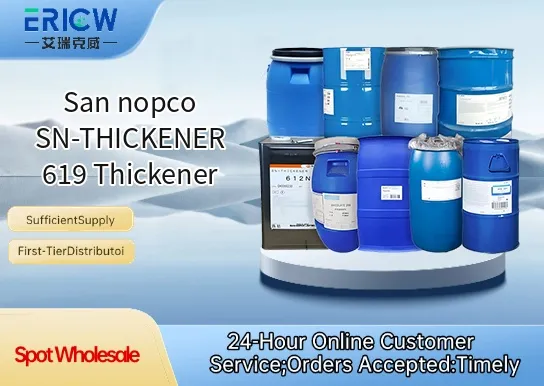
Non-ionic associative thickener delivering excellent rheology control in water-based systems.
Provides outstanding shear-thinning behavior and post-application viscosity recovery.
Compatible with a broad range of surfactants, electrolytes, and common preservatives.
Enables low-foaming performance ideal for high-shear industrial cleaning formulations.
Stable across pH 4–10, supporting robust formulation flexibility without gelation risk.
Industrial and institutional (I&I) liquid detergents and hard-surface cleaners.
Car wash concentrates and foam-control detergent systems.
Water-based metalworking fluid additives for viscosity stabilization.
Low-VOC architectural coatings requiring pseudoplastic flow behavior.
Agrochemical adjuvants for suspension stability and spray-drift reduction.
| Chemical Type | Non-ionic hydrophobically modified ethoxylated urethane (HEUR) |
| Product Form | Clear to slightly hazy aqueous solution |
| Appearance | Light amber liquid |
| pH (1% aqueous solution, 25°C) | 6.0–7.5 |
| Solids Content (wt%) | 30.0 ± 1.0 |
| Density (25°C, g/cm³) | 1.02–1.05 |
| Viscosity (Brookfield RV, 20 rpm, 25°C) | 1,500–3,500 cP |
| Primary Applications | Thickening and rheology modification in aqueous industrial formulations |
Q1: What types of formulations is SN-THICKENER 619 typically used in?
A: SN-THICKENER 619 is primarily designed for aqueous-based industrial coatings, architectural paints, and waterborne adhesives where stable, non-ionic rheology control and low-shear viscosity enhancement are required.
Q2: How does SN-THICKENER 619 differ from associative thickeners like HASE or HEUR types?
A: Unlike associative thickeners that rely on hydrophobic interactions, SN-THICKENER 619 functions as a non-ionic, water-soluble polymer thickener with primary thickening action driven by molecular entanglement and hydration. It offers good compatibility with surfactants and minimal sensitivity to electrolytes or pH shifts.
Q3: Is SN-THICKENER 619 compatible with biocides commonly used in paint systems?
A: Yes, SN-THICKENER 619 demonstrates broad compatibility with standard isothiazolinone- and formaldehyde-releasing biocides when used at typical dosage levels. As with any additive, compatibility testing under actual formulation conditions is recommended.
Q4: What is the recommended method for incorporating SN-THICKENER 619 into a formulation?
A: For optimal dispersion and performance, it is generally added during the let-down stage under moderate agitation. Pre-dilution in water or co-solvent may be beneficial to avoid localized high-concentration gelling. Avoid high-shear mixing immediately after addition to prevent mechanical degradation.
Q5: Does SN-THICKENER 619 affect film formation or drying behavior in coatings?
A: Due to its non-volatile, water-soluble nature, SN-THICKENER 619 remains in the dried film and may influence final film properties such as flexibility and water sensitivity. Its impact is formulation-dependent and should be evaluated in context with other film-forming components.
Contact With Us:
E-mail: wangxingqiang@ericwchem.com
Have a Questions? Call Us:
Add:
Building A1, Jiete Industrial Park, Huangpu District, Guangzhou City, Guangdong Province, China