English
 Español
 tiếng việt
 русский
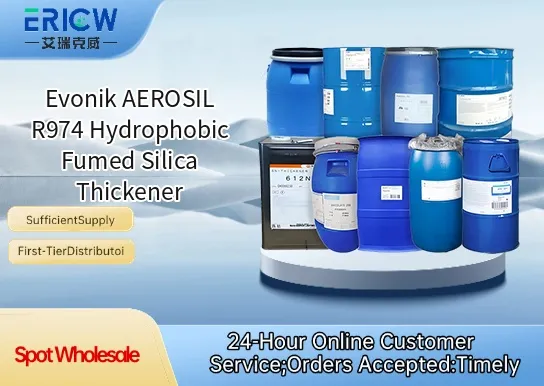
Highly hydrophobic surface treatment with dimethoxydimethylsilane for exceptional moisture resistance.
Efficient thickening and rheology control in non-aqueous systems without gelling in polar solvents.
Excellent long-term storage stability and anti-settling performance in liquid formulations.
Low dust generation and improved handling safety due to controlled particle agglomeration.
Consistent batch-to-batch performance enabled by Evonik’s proprietary fumed silica manufacturing process.
Thickening agent in solvent-based coatings and industrial paints.
Rheology modifier in adhesives and sealants, especially silicone and polyurethane systems.
Anti-sag additive in high-solids, low-VOC automotive refinish coatings.
Viscosity stabilizer in lubricating greases and specialty oils.
Structuring agent in anhydrous personal care formulations such as antiperspirant sticks and lip glosses.
| Chemical Type | Fumed silica, surface-treated with dimethoxydimethylsilane |
| Product Form | Free-flowing white powder |
| Appearance | White, amorphous, fine particulate powder |
| BET Surface Area | 100 ± 15 m²/g |
| SiO₂ Content | ≥ 99.8 wt.% |
| Ignition Loss (1000 °C) | 3.0 – 5.0 wt.% |
| Residue on Ignition (1000 °C) | ≥ 95.0 wt.% |
| pH (4% aqueous suspension) | 3.5 – 5.0 |
Q1: How does AEROSIL R974 differ from hydrophilic fumed silica grades?
A: AEROSIL R974 is surface-treated with dimethyldichlorosilane, rendering it hydrophobic—meaning it repels water and disperses readily in non-polar media such as silicones, hydrocarbons, and many organic solvents. Unlike hydrophilic grades, it does not form hydrogen bonds with water or polar resins, which enhances compatibility in anhydrous systems and improves long-term rheological stability under humid conditions.
Q2: What types of formulations benefit most from using AEROSIL R974 as a thickener?
A: It is especially effective in silicone-based systems—including RTV and HTV rubbers, silicone greases, and release coatings—as well as in solvent-borne paints, adhesives, and sealants where controlled thixotropy, anti-sag performance, and storage stability are critical. Its hydrophobic nature also supports use in moisture-sensitive applications where water absorption must be minimized.
Q3: How should AEROSIL R974 be incorporated into a formulation to achieve optimal dispersion and thickening?
A: For best results, pre-disperse AEROSIL R974 under high shear—e.g., using a dissolver, rotor-stator mixer, or three-roll mill—preferably in a portion of the base liquid prior to adding other components. Avoid low-shear mixing, which may lead to agglomeration. Post-addition milling or ultrasonication can further enhance homogeneity, particularly in highly viscous or filled systems.
Q4: Can AEROSIL R974 be used in food-contact or pharmaceutical applications?
A: AEROSIL R974 is not approved for direct food contact or pharmaceutical use. It is designed for industrial and technical applications. For regulated end-uses, consult Evonik’s regulatory documentation and confirm compliance with applicable local and regional requirements before implementation.
Q5: What is the typical dosage range for achieving desired rheology with AEROSIL R974?
A: Dosage depends heavily on the base formulation, target viscosity, and required thixotropic behavior—but it is generally effective at low concentrations, typically ranging from 0.1% to 2% by weight. Start with lower levels and incrementally adjust while monitoring dispersion quality and performance to avoid over-thickening or reduced clarity in transparent systems.
Contact With Us:
E-mail: wangxingqiang@ericwchem.com
Have a Questions? Call Us:
Add:
Building A1, Jiete Industrial Park, Huangpu District, Guangzhou City, Guangdong Province, China