English
 Español
 tiếng việt
 русский
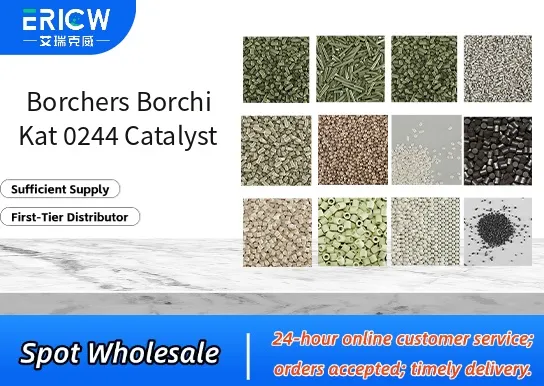
Highly selective cobalt-based catalyst for controlled oxidative crosslinking.
Low volatility formulation ensuring improved handling safety and reduced VOC emissions.
Excellent compatibility with unsaturated polyester resins and vinyl ester systems.
Enables rapid gel time adjustment without compromising final mechanical properties.
Stable performance across a broad temperature range (15–35 °C).
Fiberglass-reinforced plastic (FRP) manufacturing for tanks and pipes.
Marine gelcoat and topcoat curing in boat building.
Wind turbine blade resin systems requiring consistent through-cure.
Automotive composite parts produced via hand lay-up or spray-up processes.
Construction-grade pultruded profiles and structural panels.
| Chemical Type | Cobalt naphthenate in aromatic solvent blend |
| Product Form | Liquid solution |
| Appearance | Clear, reddish-brown liquid |
| Primary Applications | Curing agent for unsaturated polyester and vinyl ester resins |
| Key Features | Controlled reactivity, low odor, non-sedimenting |
| Benefits | Consistent gel times, enhanced surface finish, reduced styrene emissions |
| Storage Stability | 12 months at 15–25 °C in original sealed container |
| Handling Precautions | Use in well-ventilated areas; avoid skin contact and inhalation of mists |
Q1: What is the primary function of Borchi Kat 0244 in coating and ink formulations?
A: Borchi Kat 0244 is a cobalt-free, heavy-metal-free oxidation catalyst designed to promote efficient air-drying of alkyd- and oil-based systems. It accelerates surface drying and through-cure by facilitating autoxidative crosslinking without relying on regulated transition metals.
Q2: Is Borchi Kat 0244 compatible with water-reducible alkyd resins?
A: Yes — Borchi Kat 0244 demonstrates good compatibility and performance in water-reducible alkyd systems, including emulsified and pseudo-solution types. It remains effective under mild pH conditions and does not induce premature coagulation or viscosity instability when dosed appropriately.
Q3: How should Borchi Kat 0244 be incorporated into a formulation?
A: It is typically added during the let-down stage, after pigment grinding, under moderate agitation. Pre-dilution in a small portion of the binder or solvent is recommended to ensure uniform dispersion. Avoid high-shear mixing for extended periods to preserve catalytic integrity.
Q4: Does Borchi Kat 0244 affect film hardness development or yellowing tendency?
A: Borchi Kat 0244 supports balanced hardness build without excessive surface tackiness and generally contributes to improved long-term color stability compared to traditional cobalt catalysts, particularly in white and pastel systems exposed to light and heat.
Q5: What is the typical dosage range for optimal performance?
A: Dosage is formulation-dependent but generally ranges from 0.1% to 2% by weight relative to total resin solids. Starting at the lower end and adjusting based on drying profile, substrate, and ambient conditions is recommended for fine-tuning.
Contact With Us:
E-mail: wangxingqiang@ericwchem.com
Have a Questions? Call Us:
Add:
Building A1, Jiete Industrial Park, Huangpu District, Guangzhou City, Guangdong Province, China