English
 Español
 tiếng việt
 русский
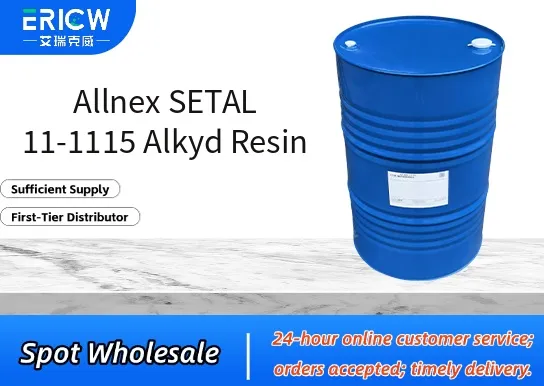
Medium-oil-length alkyd resin offering balanced drying speed and film hardness.
Excellent compatibility with common solvents, vinyls, acrylics, and melamine formaldehyde resins.
Provides good gloss retention and long-term weather resistance in exterior coatings.
Delivers superior brushability and flow-out for high-quality decorative finishes.
Formulated for low yellowing tendency, supporting stable color performance over time.
Architectural solventborne decorative paints (interior/exterior wall and trim coatings).
Industrial maintenance coatings for metal substrates requiring durability and corrosion protection.
Wood finishing systems including clear varnishes and pigmented wood stains.
General-purpose enamel coatings for appliances and metal furniture.
| Chemical Type | Medium-oil modified alkyd resin |
| Product Form | Liquid solution in aromatic hydrocarbons |
| Appearance | Clear to slightly hazy, pale yellow liquid |
| Non-Volatile Content (wt%) | ~60–65% |
| Viscosity (25°C, mPa·s) | 800–1,200 (measured in xylene solution) |
| Acid Value (mg KOH/g) | 6–10 |
| Hydroxyl Value (mg KOH/g) | 10–14 |
| Primary Applications | Decorative and protective solventborne coatings |
Q1: What is the primary application area for SETAL 11-1115?
A: SETAL 11-1115 is a medium-oil-length alkyd resin designed primarily for solventborne industrial maintenance and protective coatings, including general-purpose enamels, primers, and topcoats where balanced drying performance, gloss retention, and substrate adhesion are required.
Q2: Is SETAL 11-1115 compatible with common crosslinkers used in alkyd systems?
A: Yes — it is formulated to be compatible with standard cobalt- or manganese-based driers, as well as conventional amino resins (e.g., melamine-formaldehyde) when used in baked systems. Compatibility with specific additives or co-resins should be verified experimentally in the final formulation.
Q3: How does SETAL 11-1115 perform in terms of drying behavior and film formation?
A: It offers good through-dry and surface-dry balance under ambient conditions, supporting efficient production workflows. Film formation yields good hardness development and resistance to early water spotting, though full cure time depends on ambient temperature, humidity, and drier package selection.
Q4: Can SETAL 11-1115 be used in high-solids formulations?
A: Yes — its rheological profile and solubility characteristics support high-solids applications, typically at non-volatile contents above 60% when blended with appropriate solvents and modifiers. Formulators should optimize viscosity and sag resistance based on target application method and film build requirements.
Contact With Us:
E-mail: wangxingqiang@ericwchem.com
Have a Questions? Call Us:
Add:
Building A1, Jiete Industrial Park, Huangpu District, Guangzhou City, Guangdong Province, China