English
 Español
 tiếng việt
 русский
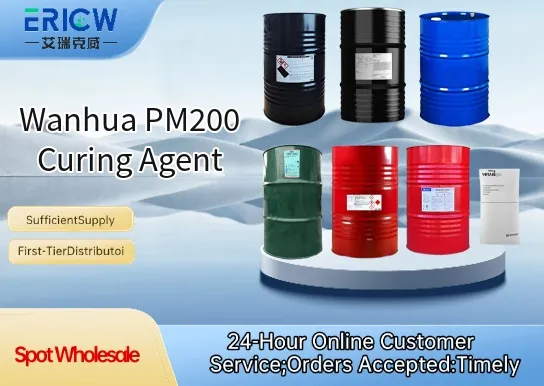
High reactivity with polyols and isocyanates for rapid gelation and reduced cycle times.
Excellent compatibility with aromatic and aliphatic isocyanate systems.
Enhanced thermal stability and long-term performance in demanding curing environments.
Low volatility and low odor, supporting safer handling and improved workplace air quality.
Consistent batch-to-batch quality ensured by Wanhua’s ISO-certified manufacturing control.
Automotive coatings requiring fast-cure, high-gloss, and weather-resistant finishes.
Industrial maintenance coatings for steel structures and heavy machinery.
Wood furniture and flooring coatings where hardness and chemical resistance are critical.
Plastic substrates coating (e.g., ABS, PC) needing flexible yet durable film formation.
High-performance coil coatings for architectural and appliance applications.
| Chemical Type | Aromatic polyisocyanate-based curing agent (modified MDI) |
| Product Form | Liquid |
| Appearance | Clear to slightly yellow transparent liquid |
| Primary Applications | Two-component polyurethane coatings and adhesives |
| Key Features | Fast-reacting, low-VOC, excellent crosslink density |
| Benefits | Improved productivity, enhanced scratch resistance, superior adhesion |
| Storage Condition | Store in sealed containers at 15–25°C; protect from moisture and direct sunlight |
| Shelf Life | 12 months from date of manufacture under recommended storage conditions |
Q1: What is the primary function of Wanhua PM200 Curing Agent in polyurethane systems?
A: Wanhua PM200 is a specialty amine-based curing agent designed to react with isocyanates in two-component polyurethane formulations, enabling rapid crosslinking and development of mechanical strength, chemical resistance, and thermal stability in the final cured film or elastomer.
Q2: Is Wanhua PM200 suitable for moisture-sensitive applications?
A: Yes — PM200 exhibits relatively low sensitivity to ambient moisture compared to highly reactive aliphatic amines, offering improved pot life and handling flexibility in controlled industrial environments. However, it should still be stored under dry, inert conditions and used with standard moisture-control practices during formulation.
Q3: How does PM200 compare to conventional aromatic diamines in terms of yellowing resistance?
A: As an aliphatic amine derivative, PM200 delivers significantly better UV stability and minimal yellowing upon exposure, making it well-suited for coatings and elastomers where long-term color retention and clarity are critical — unlike aromatic alternatives that tend to discolor rapidly under light or heat.
Q4: What types of polyurethane systems is PM200 typically used in?
A: PM200 is widely applied in high-performance 2K PU coatings for industrial equipment, automotive refinishing, and protective floorings, as well as in castable elastomers and adhesives requiring fast demold times and excellent abrasion resistance.
Q5: How should PM200 be dosed relative to the isocyanate component?
A: Dosage is formulation-dependent and must be optimized based on NCO:active-H equivalence, desired cure profile, and end-use requirements. It is typically used at low concentrations relative to the resin phase and generally ranges from 0.1% to 2% by weight of the total formulation, subject to stoichiometric adjustment and rheological considerations.
Contact With Us:
E-mail: wangxingqiang@ericwchem.com
Have a Questions? Call Us:
Add:
Building A1, Jiete Industrial Park, Huangpu District, Guangzhou City, Guangdong Province, China