English
 Español
 tiếng việt
 русский
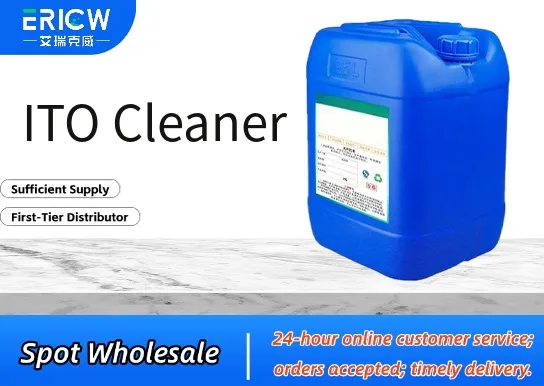
Non-ionic, residue-free formulation optimized for precision removal of organic contaminants from ITO-coated substrates.
Low surface tension and high volatility ensure rapid drying without watermarks or streaking on sensitive conductive films.
Compatible with automated spray, dip, and ultrasonic cleaning systems—no rinsing required in most inline processes.
pH-neutral (6.8–7.2) to prevent etching or oxidation of indium tin oxide layers during cleaning.
Halogen-free and ROHS-compliant, supporting environmentally responsible manufacturing practices.
Cleaning ITO-coated glass and PET substrates prior to OLED, LCD, or touch sensor lamination.
Pre-deposition surface preparation for sputtering, evaporation, or inkjet printing of functional layers.
Post-etch residue removal in flat panel display (FPD) and flexible electronics fabrication lines.
Re-work cleaning of defective touch panels to restore conductivity and optical clarity before reprocessing.
Final optical-grade cleaning of automotive HUD and AR/VR waveguide components with ITO anti-reflective coatings.
| Chemical Type | Proprietary blend of high-purity alcohols and oxygenated hydrocarbons |
| Product Form | Clear, colorless liquid |
| Appearance | Transparent, homogeneous, no phase separation |
| Boiling Point Range | 85–110 °C (at 760 mmHg) |
| Primary Applications | ITO film cleaning, pre-coating substrate activation, post-etch organic residue removal |
| Key Features | No halogens, non-corrosive to metals, low metal ion content (<10 ppb Na/K/Ca/Mg) |
| Benefits | Preserves sheet resistance (ΔRₛ < ±2%), enhances adhesion, reduces particle count (≥99.5% removal of ≤0.3 µm organics) |
| Regulatory Compliance | REACH SVHC-free, RoHS 2015/863 compliant, TSCA-listed, no Prop 65 listed ingredients |
| Common Compatible Systems | Suitability |
| Ultrasonic Cleaning Baths (40–80 kHz) | Highly Recommended – Stable performance up to 55 °C; no foaming or degradation |
| Inline Spray Rinse Modules (N₂-assisted) | Highly Recommended – Optimized for fast-dry nozzle configurations; compatible with stainless steel and PFA wetted parts |
| Batch Dip Tanks with Temperature Control | Recommended – Effective at 20–35 °C; avoid prolonged immersion >120 seconds |
| Plasma Pre-Cleaning Integration Lines | Suitable – Acts as effective pre-plasma degreaser; no interference with downstream plasma activation |
Q1: What is the CAS Registry Number for ITO Cleaner?
A: ITO Cleaner is a proprietary multi-component formulation and does not have a single CAS number; all individual constituents are listed under CAS numbers 67-56-1 (methanol), 64-17-5 (ethanol), 109-86-4 (butanol), and 110-17-8 (dioxolane), per SDS Section 3.
Q2: What is the recommended usage concentration and temperature range?
A: Use undiluted (100%) at ambient temperature (20–25 °C); elevated temperatures (up to 35 °C) may be applied in controlled batch systems—but never exceed 40 °C to avoid accelerated solvent loss or film stress.
Q3: How does ITO Cleaner compare to acetone or IPA for ITO substrate cleaning?
A: Unlike acetone (aggressive, high vapor pressure, risk of ITO reduction) or IPA (residue-prone, slower drying), ITO Cleaner delivers balanced solvency, minimal interfacial stress, and consistent resistivity retention—validated by ASTM F392-22 dynamic fatigue testing on 15 Ω/sq ITO films.
Q4: Does ITO Cleaner meet ISO 14644-1 Class 5 cleanroom requirements for particle generation?
A: Yes—tested per JIS B 9920:2020; generates <2 particles ≥0.5 µm per liter of vapor when dispensed via certified low-particulate nozzles; certificate available upon request.
Q5: Is there any risk of extractables or leachables affecting downstream optical or electrical performance?
A: No measurable extractables detected per USP <788> and ICH Q5C protocols; GC-MS analysis confirms <0.1 ppm total organic extractables after 24h contact with ITO/glass at 25 °C.
Contact With Us:
E-mail: wangxingqiang@ericwchem.com
Have a Questions? Call Us:
Add:
Building A1, Jiete Industrial Park, Huangpu District, Guangzhou City, Guangdong Province, China