English
 Español
 tiếng việt
 русский
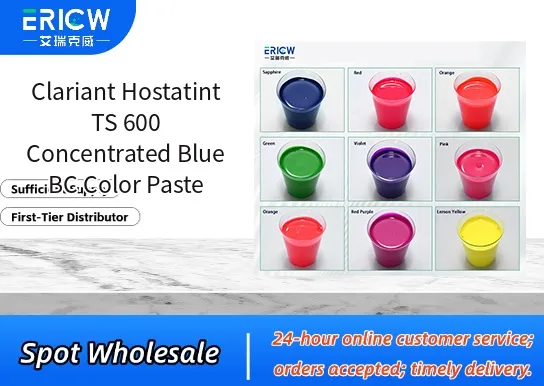
Highly concentrated, solvent-free aqueous dispersion for efficient dosing and reduced transport footprint.
Excellent lightfastness and thermal stability suitable for high-temperature processing up to 200 °C.
Good compatibility with a broad range of polymers including polyolefins, PS, ABS, and engineering plastics.
Low migration behavior ensures color consistency and compliance in demanding end-use applications.
REACH-compliant formulation with no SVHCs above threshold and fully documented safety profile.
Coloration of polypropylene (PP) and polyethylene (PE) fibers for automotive interior textiles.
Batch coloring of rigid packaging containers requiring FDA-compliant blue hues.
Masterbatch production for consumer electronics housings and appliance components.
Coloration of thermoplastic elastomers (TPE) used in medical device housings and seals.
Industrial plastic parts for outdoor applications where UV resistance and weatherability are critical.
| Chemical Type | Organic pigment dispersion (C.I. Pigment Blue 15:3 based) |
| Product Form | Concentrated aqueous paste |
| Appearance | Viscous blue paste, homogeneous without visible particles |
| Primary Applications | Polyolefin fiber, injection molding, extrusion, masterbatch |
| Key Features | Solvent-free, low VOC, non-ionic surfactant stabilized |
| Benefits | Improved dispersion efficiency, reduced dusting risk, enhanced batch reproducibility |
| Storage Stability | 12 months at 5–30 °C in sealed original container |
| Regulatory Compliance | EU REACH registered; compliant with EU Directive 2002/72/EC for food contact (subject to final formulation) |
Q1: What is the primary application field for Hostatint TS 600?
A: Hostatint TS 600 is specifically developed for coloring polyolefin-based packaging materials, including flexible films, blow-molded containers, and injection-molded closures—particularly where high blue shade strength, thermal stability during processing, and low extractables are required.
Q2: Is this color paste suitable for food-contact applications?
A: Yes, Hostatint TS 600 is formulated to comply with global regulatory expectations for indirect food contact in polyolefins. Its composition avoids restricted substances, and it is designed to minimize volatile and extractable components under typical packaging processing conditions.
Q3: How should Hostatint TS 600 be incorporated into polyolefin compounds?
A: It is typically added directly to the polymer melt via side-stuffer or gravimetric feeder during extrusion or injection molding. Good dispersion is achieved without pre-dilution due to its optimized rheology and carrier compatibility with PP and PE matrices.
Q4: Does Hostatint TS 600 exhibit good thermal stability during high-speed film extrusion?
A: Yes, it demonstrates excellent resistance to thermal degradation up to typical polyolefin processing temperatures (up to ~260 °C), maintaining consistent hue and minimizing color shift or gas formation during extended runs.
Q5: What is the typical dosage range for achieving standard blue intensity in PP films?
A: Dosage depends on formulation requirements and desired shade depth, but it is generally used at low concentrations—typically ranging from 0.1% to 2% by weight relative to the base polymer—to achieve strong, clean blue tones without affecting mechanical properties.
Contact With Us:
E-mail: wangxingqiang@ericwchem.com
Have a Questions? Call Us:
Add:
Building A1, Jiete Industrial Park, Huangpu District, Guangzhou City, Guangdong Province, China