English
 Español
 tiếng việt
 русский
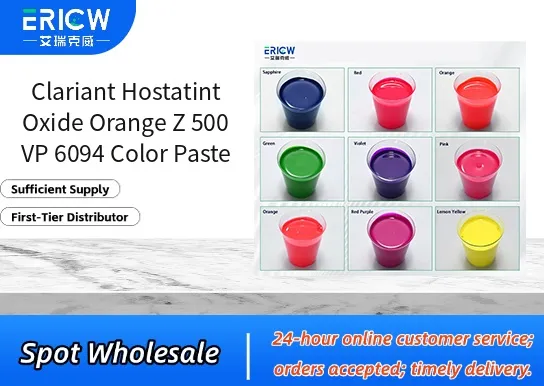
Highly concentrated iron oxide-based pigment dispersion for intense, consistent orange hue.
Optimized rheology for easy incorporation and excellent compatibility with water-based systems.
Excellent lightfastness and weather resistance suitable for demanding outdoor applications.
Low volatile organic compound (VOC) content, supporting sustainable formulation requirements.
Stable dispersion with minimal settling, ensuring long-term storage stability and batch-to-batch reproducibility.
Architectural coatings including interior and exterior wall paints.
Cementitious products such as colored concrete, mortars, and stucco.
Plaster and dry-mix rendering systems.
Tile adhesives and grouts.
Water-based industrial maintenance coatings.
| Chemical Type | Iron oxide pigment dispersion |
| Product Form | Ready-to-use liquid color paste |
| Appearance | Opaque orange paste, homogeneous consistency |
| Primary Applications | Water-based architectural and construction materials |
| Key Features | High chroma, excellent dispersion stability, low VOC |
| Benefits | Reduced formulation complexity, improved color consistency, enhanced durability |
| pH (25 °C) | 7.5–8.5 |
| Storage Temperature | 5–30 °C; protect from freezing |
Q1: What types of polymer systems is this color paste compatible with?
A: Hostatint Oxide Orange Z 500 VP 6094 is formulated for use in a broad range of thermoplastics, including polyolefins (PP, PE), PS, ABS, and engineering polymers such as PA and PC. It demonstrates good dispersion stability and thermal resistance during standard melt processing.
Q2: Is this product suitable for applications requiring regulatory compliance for food contact or toys?
A: This grade is designed to meet common regulatory expectations for colorants in polyolefin-based food-contact and toy applications, subject to final formulation validation. Users must confirm compliance with applicable local regulations and conduct required migration or extractable testing as part of their own safety assessment.
Q3: How should the color paste be incorporated into the base polymer?
A: The paste is typically added directly to the base resin using standard gravimetric or volumetric dosing equipment. Pre-blending with a portion of the base polymer prior to extrusion or injection molding is recommended to ensure uniform dispersion. Avoid excessive shear or prolonged thermal exposure during compounding.
Q4: What is the typical dosage range for achieving strong orange shades?
A: Dosage depends on the desired shade intensity and base polymer transparency, but it is generally used at low concentrations—typically ranging from 0.1% to 2% by weight relative to the total formulation.
Contact With Us:
E-mail: wangxingqiang@ericwchem.com
Have a Questions? Call Us:
Add:
Building A1, Jiete Industrial Park, Huangpu District, Guangzhou City, Guangdong Province, China