English
 Español
 tiếng việt
 русский
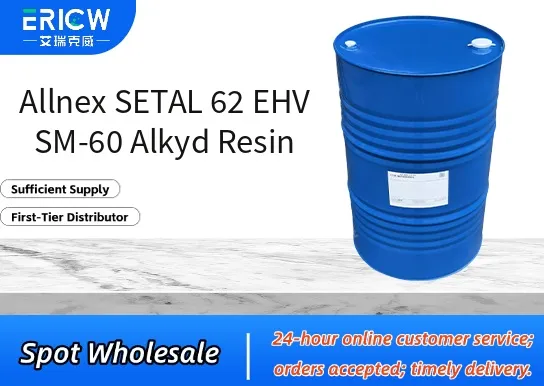
High-solids, low-VOC alkyd resin designed for environmentally compliant industrial coatings.
Excellent through-dry and hardness development at ambient cure conditions.
Superior gloss retention and long-term weather resistance in exterior applications.
Good compatibility with common acrylic and polyester co-resins for hybrid formulations.
Optimized rheology for high-film-build applications without sagging or leveling issues.
Industrial maintenance coatings for steel structures and infrastructure.
Heavy-duty marine topcoats requiring corrosion protection and UV stability.
Agricultural and construction equipment finishes.
Railway vehicle coatings demanding durability and aesthetic performance.
General-purpose protective coatings for metal substrates in aggressive environments.
| Chemical Type | Alkyd resin — long-oil modified, high-solids, air-drying |
| Product Form | Liquid |
| Appearance | Clear to pale yellow viscous liquid |
| Primary Applications | Industrial maintenance, marine, rail, and agricultural equipment coatings |
| Key Features | High-solids, low-VOC, ambient-cure, excellent weatherability |
| Benefits | Reduced solvent emissions, fast dry-to-handle, superior film integrity |
| Solvent Content (typical) | ~35–40% (by weight, in xylene/toluene blends) |
| Non-Volatile Content (typical) | 60 ± 2% (ASTM D1209) |
Q1: What is the primary function of SETAL 62 EHV SM-60 in alkyd-based coatings?
A: SETAL 62 EHV SM-60 is a high-solids, low-viscosity alkyd resin designed to enhance flow, leveling, and gloss development while maintaining good drying performance and film hardness in solventborne decorative and industrial maintenance coatings.
Q2: Is this resin suitable for water-reducible alkyd systems?
A: No — SETAL 62 EHV SM-60 is formulated for solventborne systems and is not inherently compatible with water-reducible or waterborne alkyd emulsions without significant reformulation and compatibility testing.
Q3: How does SETAL 62 EHV SM-60 compare to conventional medium-oil alkyds in terms of VOC contribution?
A: Due to its high-solids, low-viscosity profile, SETAL 62 EHV SM-60 enables formulators to reduce overall solvent demand in final coatings — supporting lower-VOC formulations without sacrificing application properties or film integrity.
Q4: Can it be used as a sole binder, or is it typically blended with other resins?
A: While functional as a stand-alone binder in certain applications, SETAL 62 EHV SM-60 is most commonly blended with melamine formaldehyde resins, urea-formaldehyde resins, or other crosslinkers to optimize cure speed, chemical resistance, and durability in baked or ambient-cure systems.
Contact With Us:
E-mail: wangxingqiang@ericwchem.com
Have a Questions? Call Us:
Add:
Building A1, Jiete Industrial Park, Huangpu District, Guangzhou City, Guangdong Province, China