English
 Español
 tiếng việt
 русский
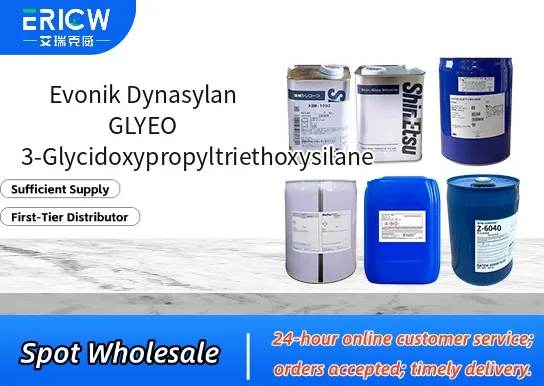
Reactive epoxy functionality enables covalent bonding with organic polymers and thermosets.
Hydrolyzable ethoxy groups provide strong adhesion to inorganic substrates such as glass, metals, and minerals.
Excellent hydrolytic stability in formulated systems prior to curing.
Low volatility and favorable handling characteristics compared to chlorosilane alternatives.
Enables improved mechanical properties—including tensile strength, flexural modulus, and impact resistance—in filled composites.
Adhesion promoter in epoxy-based structural adhesives and coatings.
Surface modifier for silica, glass fibers, and mineral fillers in composites (e.g., wind turbine blades, automotive parts).
Functional additive in UV- and thermal-curable hybrid sol-gel coatings.
Bridge molecule in silicone-epoxy hybrid resins for encapsulation and potting applications.
Performance enhancer in fiber-reinforced polymer (FRP) pultrusion and filament winding processes.
| Chemical Type | Organofunctional alkoxysilane |
| Product Form | Liquid |
| Appearance | Colorless to pale yellow clear liquid |
| Molecular Weight | 236.35 g/mol |
| Density (20 °C) | 0.97 g/cm³ |
| Refractive Index (20 °C) | 1.428–1.432 |
| Flash Point (PMCC) | 105 °C |
| Solubility | Miscible with common organic solvents (e.g., ethanol, acetone, toluene); hydrolyzes in water |
Contact With Us:
E-mail: wangxingqiang@ericwchem.com
Have a Questions? Call Us:
Add:
Building A1, Jiete Industrial Park, Huangpu District, Guangzhou City, Guangdong Province, China