English
 Español
 tiếng việt
 русский
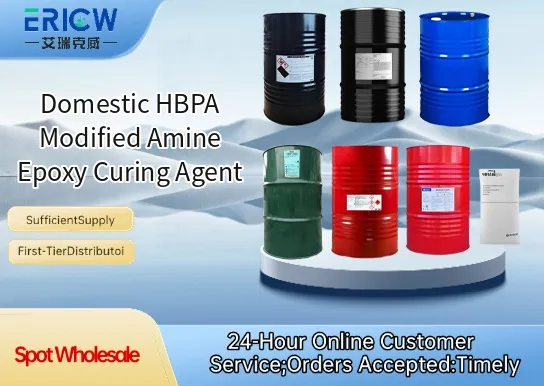
Enhanced reactivity with standard bisphenol-A epoxy resins at ambient and elevated temperatures.
Improved flexibility and impact resistance in cured epoxy systems without sacrificing thermal stability.
Low volatility and reduced amine odor compared to conventional aliphatic amines, improving workplace safety.
Good compatibility with common epoxy diluents and fillers, enabling formulation versatility.
Domestically manufactured to ensure consistent quality control and supply chain reliability.
Structural adhesives for metal-to-metal and composite bonding in automotive assembly.
Coating systems for industrial flooring requiring chemical resistance and abrasion durability.
Electrical encapsulation compounds for transformers and high-voltage components.
Repair mortars and grouts used in concrete infrastructure rehabilitation.
Composite matrix resins for wind turbine blade bonding and marine structural laminates.
| Chemical Type | HBPA-modified polyamine adduct |
| Product Form | Liquid |
| Appearance | Pale yellow to amber clear liquid |
| Viscosity (25°C) | 300–600 mPa·s |
| Density (25°C) | 1.02–1.06 g/cm³ |
| Amine Value | 280–320 mg KOH/g |
| Reactivity Profile | Medium-reactive; gel time ~45–90 min at 25°C with DGEBA resin |
| Storage Stability | 12 months in sealed container at 15–25°C |
Q1: What distinguishes this HBPA-modified amine curing agent from conventional aliphatic amines?
A: This curing agent combines the reactivity of primary/secondary amines with the steric and hydrophobic influence of hexahydrophthalic anhydride (HBPA) modification, resulting in improved pot life, reduced volatility, lower skin sensitization potential, and enhanced compatibility with aromatic epoxy resins compared to standard aliphatic amines.
Q2: Is this curing agent suitable for high-performance coating systems requiring extended service life under humid or outdoor conditions?
A: Yes — the HBPA modification imparts improved moisture resistance and reduced amine blush tendency, making it well-suited for durable industrial coatings, marine topcoats, and infrastructure protection systems where long-term adhesion and corrosion resistance are critical.
Q3: How does the cure profile compare to unmodified amine hardeners at ambient temperature?
A: It offers a balanced ambient-cure profile: faster than many polyamide-based systems but with significantly longer working time than highly reactive DETA or TETA derivatives. Full hardness and chemical resistance typically develop within 3–7 days at 20–25°C, depending on film thickness and humidity.
Q4: Can it be used in solvent-free or low-VOC epoxy formulations?
A: Yes — it is fully compatible with 100% solids epoxy resins and commonly employed in low-VOC and zero-solvent systems such as flooring mortars, grouts, and electrical encapsulants, where low volatility and controlled exotherm are advantageous.
Contact With Us:
E-mail: wangxingqiang@ericwchem.com
Have a Questions? Call Us:
Add:
Building A1, Jiete Industrial Park, Huangpu District, Guangzhou City, Guangdong Province, China