English
 Español
 tiếng việt
 русский
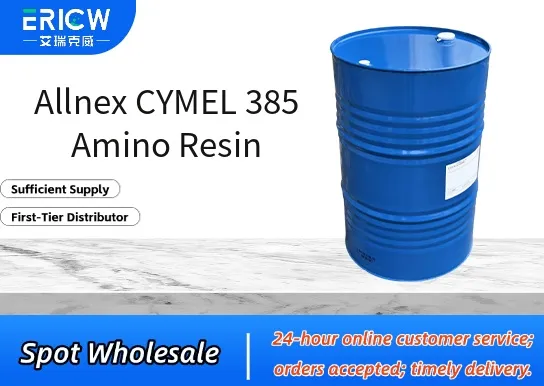
High reactivity with hydroxyl-functional resins, enabling efficient crosslinking at moderate cure temperatures.
Excellent compatibility with acrylic, polyester, and alkyd resin systems for broad formulation flexibility.
Low formaldehyde emission profile compared to conventional melamine-formaldehyde resins.
Good storage stability in solvent-based systems when properly inhibited and formulated.
Delivers superior hardness, chemical resistance, and gloss retention in thermoset coatings.
Automotive OEM and refinish topcoats requiring high durability and appearance performance.
Industrial maintenance coatings for metal substrates exposed to harsh environmental conditions.
Appliance coatings where excellent chip resistance and post-forming stability are critical.
General-purpose coil coatings for pre-painted steel and aluminum applications.
Can and closure coatings demanding FDA-compliant food-contact performance (when fully cured).
| Chemical Type | Melamine-formaldehyde crosslinker |
| Product Form | Liquid, solvent-based (typically xylene or aromatic hydrocarbon blend) |
| Appearance | Clear, pale yellow to light amber liquid |
| Non-Volatile Content (wt%) | 80–84% |
| Viscosity (25°C, mPa·s) | 1,200–2,500 |
| Density (20°C, g/cm³) | 1.16–1.20 |
| pH (10% in water) | 7.5–9.0 |
| Key Features | Low free formaldehyde, fast cure kinetics, balanced reactivity/stability |
Q1: What is the primary function of CYMEL 385 in coating formulations?
A: CYMEL 385 acts as a highly reactive crosslinker for hydroxyl- and amide-functional resins—particularly acrylics, polyesters, and alkyds—enabling durable, thermoset coatings with improved hardness, chemical resistance, and cure efficiency at moderate baking temperatures.
Q2: How does CYMEL 385 differ from other melamine-formaldehyde resins in terms of reactivity and stability?
A: CYMEL 385 features a partially methylated melamine structure offering balanced reactivity—faster than high-methylated types under catalyzed conditions, yet more storage-stable than highly reactive low-methylated variants—making it suitable for ambient-stable two-component systems and oven-cured industrial coatings.
Q3: Is CYMEL 385 compatible with acid catalysts, and what type is recommended?
A: Yes, CYMEL 385 is commonly used with strong acid catalysts such as p-toluenesulfonic acid (p-TSA) or blocked sulfonic acids to accelerate curing. Catalyst selection and dosage should be optimized based on resin compatibility, film formation requirements, and desired pot life—typically used at low concentrations to avoid premature gelation or loss of storage stability.
Q4: Can CYMEL 385 be used in waterborne coating systems?
A: Yes, CYMEL 385 is formulated to exhibit good compatibility with many water-reducible and hybrid solvent/waterborne systems, especially when properly dispersed and stabilized. Performance depends on pH control, co-solvent selection, and the hydrophilicity of the main binder; formulation testing is recommended to ensure colloidal stability and film integrity.
Q5: What are typical handling and storage recommendations for CYMEL 385?
A: Store in tightly sealed containers at temperatures between 5 °C and 30 °C, away from direct sunlight and moisture. Avoid prolonged exposure to elevated temperatures or strong acids before incorporation into the final formulation. Under recommended conditions, shelf life typically exceeds 12 months; always confirm usability via visual inspection and viscosity assessment prior to use.
Contact With Us:
E-mail: wangxingqiang@ericwchem.com
Have a Questions? Call Us:
Add:
Building A1, Jiete Industrial Park, Huangpu District, Guangzhou City, Guangdong Province, China