English
 Español
 tiếng việt
 русский
Highly concentrated iron oxide-based pigment dispersion for efficient coloration with low dosage.
Excellent thermal stability suitable for processing temperatures up to 260 °C.
Optimized rheology for easy incorporation into polymer melts and aqueous systems.
Consistent batch-to-batch color reproducibility and outstanding lightfastness (ISO 105-B02, Grade 7–8).
Free of heavy metals, compliant with EU REACH and US FDA 21 CFR §178.3297 for indirect food contact applications.
Polypropylene (PP) and polyethylene (PE) injection-molded consumer goods.
Extruded profiles and blow-molded containers for packaging and industrial use.
Masterbatch production for automotive interior components.
Water-based coatings and construction mortars requiring weather-resistant yellow hues.
Non-woven textiles and fiber extrusion where heat stability and dispersion uniformity are critical.
| Chemical Type | Iron oxide (Fe₂O₃) pigment dispersion |
| Product Form | Viscous liquid color paste |
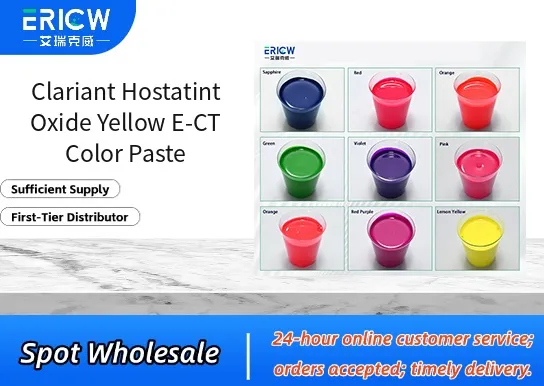
| Appearance | Opaque yellow paste, homogeneous without sedimentation |
| Primary Applications | Polyolefins, water-based coatings, construction materials |
| Key Features | Thermally stable, REACH-compliant, low migration |
| Benefits | Reduced dosing, excellent dispersibility, consistent hue |
| VOC Content | <1 % (w/w) |
| Storage Stability | 12 months at 5–30 °C in sealed original container |
Q1: What is the primary application field for Hostatint Oxide Yellow E-CT Color Paste?
A: This color paste is specifically developed for coloring polyolefin compounds—especially polypropylene (PP) and polyethylene (PE)—in applications requiring high thermal stability, good dispersion, and consistent hue reproducibility during melt processing.
Q2: Is this product suitable for food-contact plastics?
A: Hostatint Oxide Yellow E-CT is formulated with inorganic pigment technology and is intended for use in food-contact applications where regulatory compliance is required; however, final approval depends on the complete formulation, processing conditions, and applicable regional regulations—users must verify suitability with their regulatory team and relevant authorities.
Q3: How should this color paste be incorporated into polymer melts?
A: It is designed for direct addition to the polymer matrix during extrusion or injection molding. Good mixing efficiency is achieved using standard compounding equipment; pre-blending with a portion of base resin may improve dispersion uniformity, especially at lower dosage levels.
Q4: Does this paste contain heavy metals or restricted substances?
A: Hostatint Oxide Yellow E-CT is based on iron oxide yellow pigment and complies with Clariant’s internal standards for absence of intentionally added lead, cadmium, mercury, and hexavalent chromium; it is not classified as hazardous under GHS for transport or handling when used as directed.
Q5: What is the typical dosage range for achieving full opacity in PP?
A: Dosage depends on the desired shade intensity and substrate characteristics, but typical usage generally ranges from 0.1% to 2% by weight relative to the polymer—lighter tints require lower concentrations, while deeper, more opaque shades may approach the upper end of this range.
Contact With Us:
E-mail: wangxingqiang@ericwchem.com
Have a Questions? Call Us:
Add:
Building A1, Jiete Industrial Park, Huangpu District, Guangzhou City, Guangdong Province, China