English
 Español
 tiếng việt
 русский
High chroma and excellent lightfastness (ISO 105-B02, Grade 7–8)
Outstanding thermal stability up to 280 °C for demanding polymer processing
Superior resistance to migration and blooming in PVC and polyolefin compounds
Optimized particle size distribution for enhanced dispersion and gloss retention
Compliant with global regulatory frameworks including EU REACH and US FDA 21 CFR §178.3297
Automotive interior plastics (dashboards, trim, seat components)
Engineering thermoplastics (PP, PE, ABS, PC/ABS blends)
Wire and cable jacketing compounds requiring UL94 V-0 compliance
High-performance industrial coatings for metal and plastic substrates
Food-contact-approved packaging films and containers (subject to formulation validation)
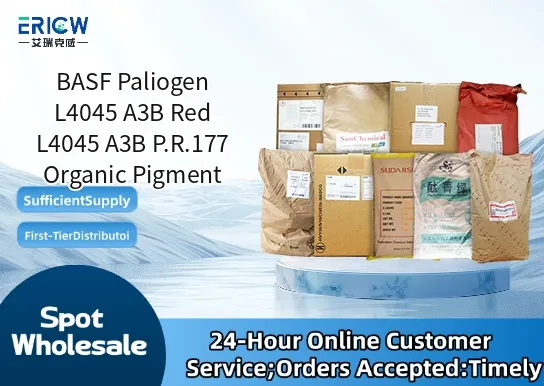
| Chemical Type | Polycyclic Quinacridone Derivative (Pigment Red 177) |
| Product Form | Free-flowing powder |
| Appearance | Deep bluish-red powder |
| Primary Applications | Polymer coloration, high-performance coatings |
| Key Features | High heat stability, low volatility, excellent dispersibility |
| Benefits | Color consistency across processing cycles, minimal plate-out in extrusion |
| Regulatory Status | REACH registered; compliant with OECD TG 404 (skin irritation) |
| Storage Conditions | Store in cool, dry place below 30 °C; protect from moisture and direct sunlight |
Q1: What are the key performance advantages of Paliogen L4045 A3B compared to other PR.177 pigments?
A: Paliogen L4045 A3B offers excellent heat stability, good lightfastness, and high tinting strength, making it particularly suitable for demanding polymer applications such as engineering plastics and automotive interior parts where long-term color retention under thermal stress is critical.
Q2: Is this pigment suitable for use in polyolefins like PP or PE?
A: Yes — Paliogen L4045 A3B is widely used in polyolefin applications, including injection-molded and extruded PP and HDPE components. Its dispersibility and thermal stability support processing at typical polyolefin melt temperatures without significant degradation or color shift.
Q3: How does this pigment perform in high-temperature engineering plastics such as PBT or PA6?
A: It demonstrates robust thermal stability in engineering thermoplastics processed up to approximately 280 °C, retaining strong red hue and minimal charring tendency — especially when compounded with appropriate stabilizer systems and optimized residence time.
Q4: What is the recommended dispersion method for optimal color development?
A: For best results, use high-shear compounding — such as twin-screw extrusion — with controlled temperature profiles and adequate residence time. Pre-dispersed masterbatches are also commonly employed to ensure uniform distribution and maximize color strength and gloss in final parts.
Contact With Us:
E-mail: wangxingqiang@ericwchem.com
Have a Questions? Call Us:
Add:
Building A1, Jiete Industrial Park, Huangpu District, Guangzhou City, Guangdong Province, China