English
 Español
 tiếng việt
 русский
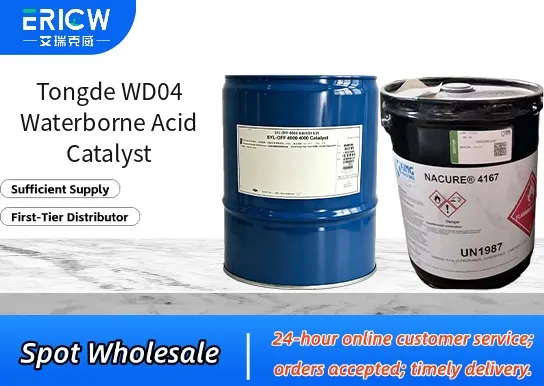
Waterborne formulation ensures low VOC content and compliance with stringent environmental regulations.
Controlled acid strength enables precise catalytic activity for urethane and melamine crosslinking without premature gelation.
Excellent compatibility with acrylic, polyester, and polyurethane dispersions in aqueous systems.
Stable dispersion at pH 3.5–5.0, minimizing hydrolysis risk in water-based coatings and adhesives.
Non-corrosive to common industrial equipment, supporting safe handling and extended storage stability.
Waterborne automotive clearcoats and basecoats requiring fast ambient-cure kinetics.
Industrial maintenance coatings for metal substrates with high film hardness and chemical resistance.
Low-bake wood finishing systems (e.g., MDF, particleboard) where heat-sensitive substrates limit curing temperature.
Water-based can coatings for food and beverage packaging with FDA-compliant formulation pathways.
Architectural interior wall paints needing enhanced scrub resistance and early-block resistance.
| Chemical Type | Sulfonic acid-functionalized polymer dispersion |
| Product Form | Aqueous liquid dispersion |
| Appearance | Clear to slightly hazy, colorless to pale yellow liquid |
| pH (10% aqueous solution) | 3.8–4.2 |
| Solids Content (wt%) | 25–28% |
| Density (25°C) | 1.02–1.05 g/cm³ |
| Viscosity (Brookfield, #2 spindle, 20 rpm, 25°C) | 80–150 mPa·s |
| Storage Stability (unopened, 5–30°C) | ≥12 months |
Q1: What is the primary function of Tongde WD04 in waterborne coating systems?
A: Tongde WD04 is a water-dispersible acid catalyst designed to accelerate crosslinking reactions—particularly with melamine-formaldehyde and carbamate-based resins—in waterborne industrial coatings and inks. It enhances cure speed and film hardness at ambient or low-bake conditions without compromising colloidal stability.
Q2: Is Tongde WD04 compatible with common waterborne resin systems such as acrylics, polyurethanes, and hybrid dispersions?
A: Yes, Tongde WD04 demonstrates broad compatibility with anionic and non-ionic waterborne acrylics, polyurethane dispersions (PUDs), and acrylic-PUD hybrids. It is formulated to minimize pH shock and avoid destabilization during incorporation, though compatibility testing under actual formulation conditions is recommended prior to full-scale use.
Q3: How should Tongde WD04 be incorporated into a waterborne formulation?
A: It is typically added during the let-down stage, after main resin dispersion and pigments are stabilized. Stir gently under moderate shear to ensure uniform distribution. Avoid high-shear mixing for extended periods to prevent potential agglomeration or viscosity drift. Pre-dilution with deionized water may aid dispersion in sensitive systems.
Q4: Does Tongde WD04 affect the storage stability of waterborne coatings?
A: When used within typical dosage ranges and properly integrated, Tongde WD04 does not adversely impact shelf life. However, excessive addition or improper pH adjustment may accelerate hydrolysis of acid-sensitive resins. Formulators should monitor viscosity, pH, and particle size over time in accelerated stability trials.
Q5: Can Tongde WD04 be used in low-VOC or zero-VOC compliant formulations?
A: Yes—Tongde WD04 contains no added volatile organic compounds (VOCs) and is fully waterborne, supporting compliance with stringent low-VOC regulatory frameworks for architectural, industrial, and protective coatings.
Contact With Us:
E-mail: wangxingqiang@ericwchem.com
Have a Questions? Call Us:
Add:
Building A1, Jiete Industrial Park, Huangpu District, Guangzhou City, Guangdong Province, China