English
 Español
 tiếng việt
 русский
Excellent abrasion resistance for extended service life in demanding mechanical environments.
High tensile strength and elongation at break, enabling robust performance under dynamic stress.
Good low-temperature flexibility down to –30 °C, maintaining elasticity in cold-condition applications.
Outstanding oil and grease resistance, ensuring dimensional stability in contact with hydrocarbon-based fluids.
Processable via standard thermoplastic equipment including extrusion, injection molding, and blow molding.
Automotive interior trim components such as door panels, armrests, and gear knobs.
Industrial hoses and fluid transfer tubing requiring chemical resistance and flexibility.
Consumer electronics protective casings and wearable device straps.
Medical tubing and non-invasive device housings compliant with ISO 10993 biocompatibility guidelines.
Footwear midsoles and outsoles requiring high rebound and wear resilience.
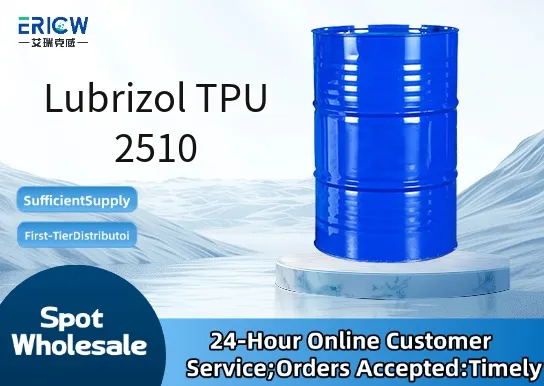
| Chemical Type | Thermoplastic Polyurethane (TPU), polyester-based |
| Product Form | Natural-colored pellets |
| Appearance | Opaque, uniform granules |
| Primary Applications | Extruded profiles, molded parts, flexible tubing |
| Key Features | Abrasion resistance, oil resistance, low-temperature flexibility |
| Benefits | Enhanced durability, processing efficiency, design freedom |
| Processing Method | Injection molding, extrusion, blow molding |
| Compliance | RoHS compliant; meets UL 94 HB flammability rating |
Q1: What is Lubrizol TPU 2510 primarily used for?
A: Lubrizol TPU 2510 is a thermoplastic polyurethane-based additive designed to enhance melt processability, improve surface finish, and reduce friction in thermoplastic elastomer (TPE) and engineering thermoplastic formulations—especially in extruded or injection-molded parts requiring low coefficient of friction and good release characteristics.
Q2: Is Lubrizol TPU 2510 compatible with common thermoplastics like TPEs, TPOs, and polyolefins?
A: Yes, TPU 2510 demonstrates broad compatibility with thermoplastic elastomers (e.g., SEBS, TPE-S), thermoplastic olefins (TPO), polypropylene (PP), and certain polyethylene (PE) systems. Compatibility should be verified experimentally in the final compound due to formulation-specific interactions.
Q3: How is Lubrizol TPU 2510 typically incorporated into a polymer system?
A: It is generally introduced via dry blending prior to extrusion or directly fed into the extruder throat. Due to its thermoplastic nature, it melts and disperses readily during standard compounding processes without requiring pre-dissolution or special handling.
Q4: Does Lubrizol TPU 2510 affect the mechanical properties of the base polymer?
A: At typical use levels, TPU 2510 is formulated to minimize impact on tensile strength, elongation, and hardness. Some reduction in modulus may occur at higher loadings, but optimized dosing generally preserves key mechanical performance while delivering functional benefits.
Contact With Us:
E-mail: wangxingqiang@ericwchem.com
Have a Questions? Call Us:
Add:
Building A1, Jiete Industrial Park, Huangpu District, Guangzhou City, Guangdong Province, China