English
 Español
 tiếng việt
 русский
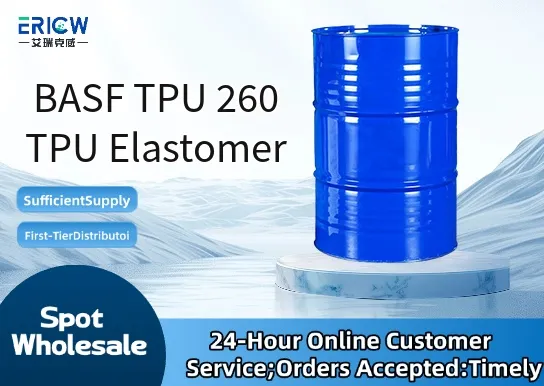
Excellent abrasion resistance for demanding mechanical environments.
Good low-temperature flexibility down to –30 °C.
High tensile strength and elongation at break for dynamic applications.
Outstanding processability in extrusion, injection molding, and calendering.
Good resistance to oils, greases, and many non-polar solvents.
Automotive interior trim components (e.g., gear knobs, armrests).
Industrial hoses and pneumatic tubing requiring flexibility and durability.
Consumer electronics protective casings and wearable device straps.
Medical tubing and non-implantable fluid handling components.
Footwear midsoles and performance outsole overlays.
| Chemical Type | Thermoplastic Polyurethane (TPU), Polyester-based |
| Product Form | Natural-colored pellets |
| Appearance | Opaque, uniform cylindrical pellets |
| Hardness (Shore A) | 95 ± 2 |
| Melt Flow Index (230 °C / 2.16 kg) | 10–14 g/10 min |
| Density (23 °C) | 1.20–1.23 g/cm³ |
| Tensile Strength (ISO 527) | 45–52 MPa |
| Elongation at Break (ISO 527) | 550–620 % |
Q1: What are the key processing methods suitable for BASF TPU 260?
A: BASF TPU 260 is designed for melt-processing techniques including injection molding, extrusion, and blow molding. Its balanced melt viscosity and thermal stability support consistent flow and good surface finish across these methods, particularly in thin-wall and complex-geometry applications.
Q2: How does BASF TPU 260 compare to other TPU grades in terms of hardness and flexibility?
A: BASF TPU 260 is a medium-hardness thermoplastic polyurethane elastomer, offering a favorable balance between rigidity and elasticity. It delivers higher tensile strength and abrasion resistance than softer TPU grades, while maintaining greater flexibility and impact resilience than rigid engineering thermoplastics like rigid PVC or certain polyesters.
Q3: Is BASF TPU 260 suitable for applications requiring good low-temperature performance?
A: Yes — BASF TPU 260 retains useful elasticity and impact resistance at sub-zero temperatures, making it appropriate for outdoor, automotive, and industrial components exposed to cold environments. Its performance remains stable down to approximately −30 °C, though exact behavior depends on part geometry and service conditions.
Q4: Can BASF TPU 260 be used in contact with food or potable water?
A: BASF TPU 260 is not pre-certified for direct food contact or potable water applications. Customers intending such use must conduct full regulatory evaluation based on final formulation, processing conditions, and applicable regional requirements. BASF provides technical support for migration testing and compliance documentation upon request.
Contact With Us:
E-mail: wangxingqiang@ericwchem.com
Have a Questions? Call Us:
Add:
Building A1, Jiete Industrial Park, Huangpu District, Guangzhou City, Guangdong Province, China