English
 Español
 tiếng việt
 русский
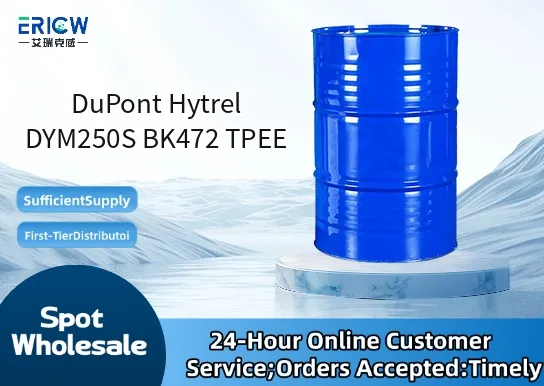
High-performance thermoplastic elastomer with excellent melt processability for injection molding and extrusion.
Outstanding resistance to oils, greases, and many automotive fluids at elevated temperatures.
Retains flexibility and toughness down to –40 °C while maintaining dimensional stability.
Black color (BK472) with consistent pigment dispersion and no bloom or migration.
Good UV and weather resistance suitable for long-term outdoor applications.
Automotive under-hood components including fluid handling hoses and connectors.
Industrial power transmission belts requiring high fatigue resistance and temperature resilience.
Seals and gaskets for hydraulic and pneumatic systems exposed to aggressive media.
Consumer appliance parts such as flexible couplings and vibration-damping mounts.
Medical tubing and device housings where biocompatibility support and sterilization resistance are required.
| Chemical Type | Thermoplastic Polyester Elastomer (TPEE) |
| Product Form | Pellets |
| Appearance | Black, free-flowing pellets |
| Primary Applications | Fluid handling, dynamic seals, flexible structural components |
| Key Features | Oil resistance, low-temperature flexibility, high creep resistance |
| Processing Methods | Injection molding, extrusion, blow molding |
| Standards Compliance | Meets UL 94 HB flammability rating; RoHS compliant |
| Storage Recommendation | Store in original sealed packaging at <25 °C and <50% RH |
Q1: What is the primary functional role of Hytrel DYM250S BK472 in compound formulations?
A: Hytrel DYM250S BK472 is a pre-colored thermoplastic elastomer (TPEE) grade designed primarily as a performance modifier and carrier resin—commonly used to impart elasticity, abrasion resistance, and thermal resilience to blends, especially where consistent black coloration and melt-processability are required.
Q2: Is this grade suitable for overmolding onto rigid thermoplastics like PBT or PC?
A: Yes—Hytrel DYM250S BK472 exhibits good adhesion to many engineering thermoplastics when processed under appropriate temperature and mold surface conditions. Optimal bonding typically requires careful control of melt temperature, mold temperature, and interfacial cleanliness during two-shot or insert molding.
Q3: How does the BK472 black colorant system perform under UV exposure and thermal aging?
A: The BK472 pigment system is formulated for enhanced stability in demanding environments. It demonstrates improved resistance to UV-induced fading and thermal discoloration compared to standard carbon-black masterbatches, particularly in thin-wall or outdoor-exposed applications—though long-term performance depends on part geometry, stress state, and service conditions.
Q4: Can Hytrel DYM250S BK472 be blended with other TPEEs or thermoplastic polyesters?
A: Yes—it is chemically compatible with other Hytrel TPEE grades and certain polyester-based thermoplastics. However, blend compatibility should be verified experimentally for each specific formulation, as phase separation or property dilution may occur depending on molecular weight distribution and thermal history.
Contact With Us:
E-mail: wangxingqiang@ericwchem.com
Have a Questions? Call Us:
Add:
Building A1, Jiete Industrial Park, Huangpu District, Guangzhou City, Guangdong Province, China