English
 Español
 tiếng việt
 русский
Excellent low-temperature flexibility with outstanding impact resistance down to –40 °C
Superior melt processability for high-speed extrusion and injection molding
Outstanding compatibility with polypropylene (PP) and polyethylene (PE) for robust thermoplastic vulcanizate (TPV) and TPO formulations
Good UV and thermal oxidative stability, enabling extended outdoor service life
Low extractables and excellent colorability for demanding consumer and automotive applications
Automotive interior trim components including door panels, instrument bezels, and soft-touch surfaces
Flexible packaging seals and closures requiring toughness and seal integrity
Consumer appliance grips, housings, and overmolded handles
Medical tubing and device components where clarity, flexibility, and biocompatibility support are valued
Industrial hoses and gaskets requiring dynamic flex fatigue resistance
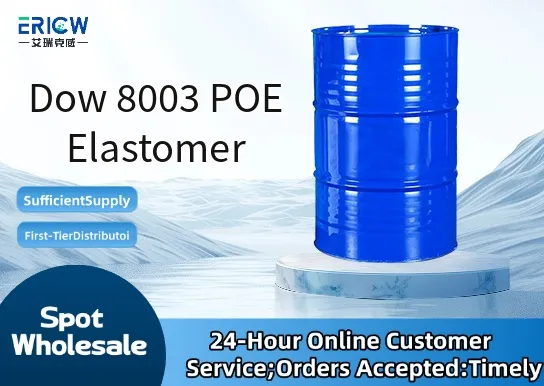
| Chemical Type | Polyolefin Elastomer (POE), ethylene-octene copolymer |
| Product Form | Pellets |
| Appearance | Off-white to light tan, free-flowing pellets |
| Primary Applications | TPO compounding, soft-touch overmolding, flexible packaging, automotive elastomeric parts |
| Key Features | High elasticity, excellent PP/PE compatibility, low density, good processability |
| Benefits | Enables lightweight part design, reduces cycle times, improves impact performance at low temperatures |
| Processing Method | Injection molding, extrusion, blow molding, twin-screw compounding |
| Regulatory Compliance | Meets FDA 21 CFR §177.1520 for food-contact applications (subject to formulation and processing conditions) |
Q1: What is Dow 8003 POE Elastomer primarily used for?
A: Dow 8003 is a polyolefin elastomer designed to enhance impact resistance, flexibility, and melt processability in polypropylene (PP) and polyethylene (PE) compounds—commonly used in automotive interior trim, durable consumer goods, and flexible packaging layers.
Q2: How does Dow 8003 differ from conventional EPDM or EPR impact modifiers?
A: Unlike traditional diene-based elastomers, Dow 8003 is a metallocene-catalyzed ethylene-octene copolymer with narrow molecular weight distribution and uniform comonomer incorporation—offering superior dispersion in PP matrices, improved clarity in thin sections, and more consistent rheological behavior during extrusion and injection molding.
Q3: Is Dow 8003 compatible with filled or reinforced polypropylene systems?
A: Yes—it demonstrates good compatibility with calcium carbonate, talc, and glass fiber-filled PP formulations, helping to mitigate stiffness–toughness trade-offs without significantly compromising tensile strength or heat deflection temperature.
Q4: What processing advantages does Dow 8003 offer compared to higher-melt-flow POEs?
A: With its balanced melt viscosity, Dow 8003 supports stable extrusion and uniform dispersion at typical processing temperatures (180–230 °C), while minimizing die swell and melt fracture—making it especially suitable for coextruded multilayer structures and thin-wall injection molding applications.
Contact With Us:
E-mail: wangxingqiang@ericwchem.com
Have a Questions? Call Us:
Add:
Building A1, Jiete Industrial Park, Huangpu District, Guangzhou City, Guangdong Province, China