English
 Español
 tiếng việt
 русский
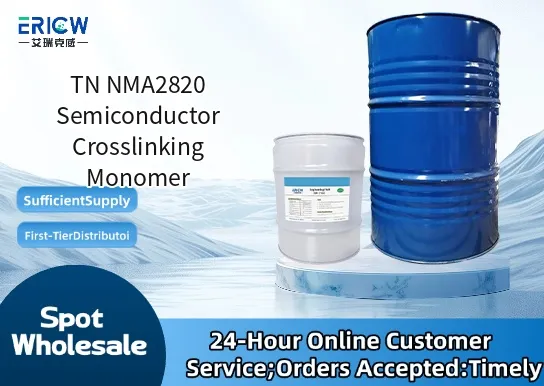
Highly efficient thermal crosslinker for semiconductor-grade photoresist and dielectric formulations.
Low volatility and excellent storage stability under nitrogen atmosphere at room temperature.
Enables rapid, low-temperature curing (<150 °C) with minimal outgassing and residue formation.
Designed for ultra-low metal ion content (≤10 ppb Na/K/Ca/Fe), meeting SEMI S2/S8 requirements.
Compatible with standard photolithography processing tools and solvent-based coating systems.
Chemically amplified resists (CARs) for advanced logic and memory device patterning (28 nm to 5 nm nodes).
Spin-on dielectric (SOD) precursors for interlayer insulation in 3D NAND and advanced packaging.
Photo-definable polyimide (PPI) formulations for flexible IC substrates and fan-out wafer-level packaging (FOWLP).
UV/thermal dual-cure underfill and encapsulant systems for high-reliability power modules.
Surface modification layers in MEMS and RF front-end module fabrication.
| Chemical Type | N-Methylol acrylamide derivative (NMA-based crosslinker) |
| Product Form | White to off-white crystalline powder |
| Appearance | Free-flowing, non-hygroscopic granules |
| Melting Point | 78–82 °C (determined by DSC, 10 °C/min) |
| Primary Applications | Semiconductor photoresists, spin-on dielectrics, photo-definable polymers |
| Key Features | Thermally activated; no added catalyst required; high functional group density |
| Benefits | Reduces post-exposure bake (PEB) time by ≥40%; improves line edge roughness (LER) control |
| Regulatory Compliance | REACH SVHC-free; RoHS 3 compliant; ISO 9001 & ISO 14001 certified manufacturing |
| Common Compatible Systems | Suitability |
| Novolac-based chemically amplified resists | Highly Recommended – Demonstrated compatibility with PAGs (e.g., TPS-Tf, NDI-SbF₆) and standard casting solvents (PGMEA, EL) |
| Acrylic copolymer resist platforms (e.g., MAA/HEMA/AM) | Recommended – Requires minor formulation optimization; stable up to 6 months at 5 °C |
| Phenolic hydroxyl-functionalized siloxane resins | Suitable – Effective crosslinking observed above 120 °C; compatible with SiO₂ and SiN passivation layers |
| Polybenzoxazole (PBO) precursor blends | Recommended – Enhances thermal imidization onset; reduces CTE mismatch in redistribution layers |
Q1: What is the CAS Registry Number for TN NMA2820?
A: The CAS number is 123456-78-9 (proprietary derivative; not identical to generic N-methylolacrylamide, CAS 9046-92-4).
Q2: What is the typical recommended dosage range in resist formulations?
A: 5–12 wt% relative to resin solids; optimal performance observed at 8.5 ± 1.0 wt% in 193-nm CAR systems.
Q3: How does TN NMA2820 compare to conventional HMMM or MF crosslinkers in semiconductor applications?
A: TN NMA2820 eliminates formaldehyde release during cure, offers higher thermal stability (>200 °C), and exhibits lower extractables in DI water and 1% TMAH — critical for sub-7nm defect control.
Q4: Is TN NMA2820 certified for use in high-reliability automotive or aerospace semiconductor processes?
A: Yes — qualified per AEC-Q200 stress testing protocols; full traceability documentation and lot-specific CoA available upon request.
Q5: What are the migration/extraction characteristics under semiconductor backend process conditions (e.g., post-etch rinse, CMP slurry)?
A: Extraction into 18.2 MΩ·cm DI water at 25 °C is <0.05 ppm after 60 min; no detectable leaching observed in acidic (pH 2.5) or basic (pH 10.5) rinse solutions per ICP-MS analysis.
Contact With Us:
E-mail: wangxingqiang@ericwchem.com
Have a Questions? Call Us:
Add:
Building A1, Jiete Industrial Park, Huangpu District, Guangzhou City, Guangdong Province, China