English
 Español
 tiếng việt
 русский
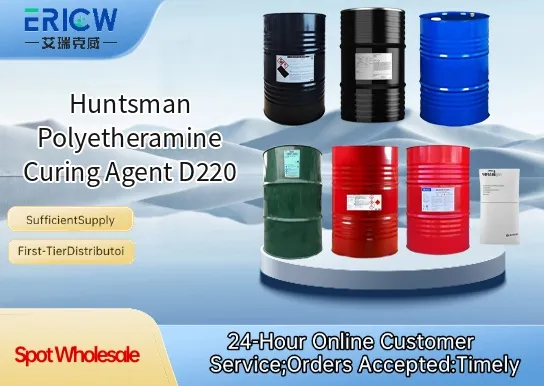
Low-viscosity liquid enabling easy handling and efficient mixing with epoxy resins.
Fast reactivity at ambient temperature, supporting rapid cure cycles without external heat.
Excellent flexibility and impact resistance in cured epoxy systems.
Superior adhesion to diverse substrates including metals, composites, and concrete.
Low volatility and low odor, contributing to improved workplace safety and reduced VOC emissions.
Structural adhesives for automotive and aerospace bonding.
Coating systems requiring toughness and chemical resistance, such as industrial floor coatings.
Electrical encapsulants and potting compounds for electronics protection.
Composite matrix resins for wind turbine blades and sporting goods.
Repair mortars and grouts in infrastructure maintenance applications.
| Chemical Type | Polyoxypropylene-based diamine |
| Product Form | Liquid |
| Appearance | Clear, pale yellow liquid |
| Amine Value | 425–465 mg KOH/g |
| Color (APHA) | ≤100 |
| Viscosity (25°C) | 150–250 mPa·s |
| Primary Applications | Epoxy resin curing agent for adhesives, coatings, and composites |
| Key Features | Fast ambient cure, low viscosity, high flexibility, low volatility |
Q1: What is the primary function of D220 in epoxy systems?
A: D220 is a low-molecular-weight polyetheramine curing agent designed to react with epoxy resins, enabling rapid ambient- or elevated-temperature cure. It delivers flexible, tough, and chemically resistant thermoset networks with low viscosity and extended pot life.
Q2: How does D220 compare to traditional amine hardeners in terms of handling and safety?
A: Compared to many aliphatic amines, D220 exhibits lower volatility, reduced skin sensitization potential, and milder odor—contributing to improved workplace handling and safer processing without compromising reactivity or final performance.
Q3: Can D220 be used in moisture-sensitive applications?
A: Yes—D220 has relatively low sensitivity to atmospheric moisture compared to highly reactive amines like DETA or TETA, making it suitable for applications where controlled processing in moderate humidity is required, though standard moisture protection during storage remains recommended.
Q4: Is D220 compatible with modified epoxy resins (e.g., novolacs, cycloaliphatics, or brominated types)?
A: D220 demonstrates broad compatibility across conventional diglycidyl ether of bisphenol-A (DGEBA) and bisphenol-F resins, as well as many modified epoxies—including cycloaliphatic and certain functionalized novolac systems—though formulation-specific testing is advised to confirm cure profile and property development.
Q5: What are typical dosage guidelines when formulating with D220?
A: Dosage depends on the epoxy resin’s equivalent weight and desired performance balance, but D220 is typically used at low concentrations relative to resin weight—generally ranging from 0.1% to 2% by weight for catalytic or co-curing roles, or stoichiometrically adjusted for full amine-based cure in structural applications.
Contact With Us:
E-mail: wangxingqiang@ericwchem.com
Have a Questions? Call Us:
Add:
Building A1, Jiete Industrial Park, Huangpu District, Guangzhou City, Guangdong Province, China