English
 Español
 tiếng việt
 русский
Exceptional thermal stability up to 250 °C, maintaining viscosity and integrity under prolonged high-temperature exposure.
Outstanding oxidative resistance due to phenyl group incorporation, minimizing degradation in air-rich or catalytic environments.
Broad compatibility with organic solvents, resins, and elastomers—ideal for formulation integration without phase separation.
Low volatility and negligible vapor pressure at room temperature, supporting safe handling and reduced evaporative loss.
Tailored phenyl-to-methyl ratio providing balanced flexibility, refractive index (~1.53), and UV transparency for optical-grade uses.
High-performance release agents for silicone rubber and composite molding (e.g., aerospace RTM, automotive LCM).
Base fluid in thermally stable dielectric fluids for high-voltage transformers and electronic potting compounds.
Viscosity modifier and stress-relief additive in high-temp adhesives, sealants, and encapsulants.
Carrier medium for specialty pigments and UV-curable additives in premium coatings and inks.
Component in optical gels and lens bonding formulations requiring long-term clarity and refractive index matching.
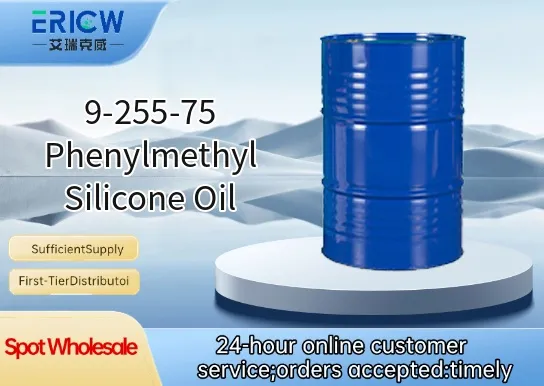
| Chemical Type | Phenylmethyl polysiloxane |
| Product Form | Clear, colorless to pale yellow liquid |
| Appearance | Homogeneous, free from sediment or haze |
| Viscosity (25 °C, cSt) | 75 ± 5 |
| Density (25 °C, g/cm³) | 1.04–1.06 |
| Refractive Index (25 °C) | 1.528–1.532 |
| Flash Point (COC, °C) | ≥300 |
| Volatility (200 °C, 24 h, wt%) | <1.5 |
Q1: What distinguishes 9-255-75 Phenylmethyl Silicone Oil from standard dimethyl silicone oils?
A: The phenyl groups in its backbone significantly enhance thermal stability, UV resistance, and compatibility with aromatic solvents and polymers—making it especially suitable for high-performance coatings, optical gels, and specialty elastomer formulations where conventional methyl-based silicones may degrade or phase-separate.
Q2: Is this product suitable for use in cosmetics or personal care formulations?
A: Yes, 9-255-75 Phenylmethyl Silicone Oil is widely used in premium skincare, haircare, and color cosmetics for its elegant sensory profile, non-greasy spreadability, and ability to improve pigment dispersion and film-forming properties—provided it meets applicable regional safety and purity requirements for cosmetic-grade materials.
Q3: How does viscosity affect its performance in industrial release applications?
A: Viscosity directly influences film uniformity and release efficiency: lower-viscosity grades offer better substrate wetting and faster leveling on molds, while higher-viscosity versions provide longer-lasting barrier films—selection should align with substrate geometry, cure temperature, and required release cycles.
Q4: Can it be blended with other silicone fluids or organic carriers?
A: Yes, 9-255-75 exhibits good miscibility with most methylphenyl, phenylvinyl, and dimethyl silicone fluids, as well as common hydrocarbon and ester-based carriers—though compatibility testing is recommended when combining with highly polar or reactive components to ensure long-term stability.
Contact With Us:
E-mail: wangxingqiang@ericwchem.com
Have a Questions? Call Us:
Add:
Building A1, Jiete Industrial Park, Huangpu District, Guangzhou City, Guangdong Province, China