English
 Español
 tiếng việt
 русский
High chroma and excellent color consistency across batches.
Outstanding thermal stability up to 280°C for demanding processing conditions.
Low volatility and minimal extractables, supporting regulatory compliance in sensitive applications.
Optimized dispersibility in both polar and non-polar polymer matrices.
UV-resistant formulation ensuring long-term color retention under outdoor exposure.
Automotive interior and exterior plastic components.
Medical device housings requiring biocompatibility-supportive colorants.
Consumer electronics enclosures with high-gloss finish requirements.
Industrial packaging films where lightfastness and migration resistance are critical.
Engineering thermoplastics including polypropylene, ABS, and polycarbonate blends.
| Chemical Type | Organic pigment dispersion (non-heavy-metal) |
| Product Form | Free-flowing powder |
| Appearance | Uniform granular powder, free of lumps or dust |
| Primary Applications | Coloration of engineering thermoplastics and elastomers |
| Key Features | Thermal stability, low extractables, high tinctorial strength |
| Benefits | Consistent batch-to-batch performance, reduced processing variability |
| Storage Conditions | Store in cool, dry location; avoid direct sunlight and moisture |
| Regulatory Status | Compliant with FDA 21 CFR §178.3290 and EU Directive 2011/65/EU (RoHS) |
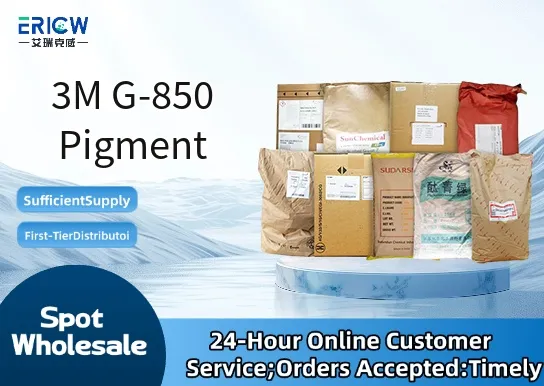
Q1: What is the primary function of 3M G-850 Pigment in polymer systems?
A: 3M G-850 Pigment is a high-performance, thermally stable colorant designed to provide consistent hue, excellent dispersion, and strong chromatic strength in demanding polymer applications—particularly in engineering thermoplastics and high-heat processing environments.
Q2: Is 3M G-850 Pigment suitable for food-contact or medical-grade polymers?
A: 3M G-850 Pigment is not pre-certified for food-contact or medical applications. Its suitability depends on final formulation compliance with applicable regulatory requirements; users must conduct full regulatory evaluation—including extractables testing and end-use validation—prior to use in such sensitive applications.
Q3: How should 3M G-850 Pigment be incorporated into polymer melts?
A: It is typically introduced via masterbatch dilution or direct addition during compounding. Good melt mixing and sufficient residence time are recommended to ensure uniform dispersion; compatibility with standard twin-screw extrusion and injection molding processes has been demonstrated across multiple resin types.
Q4: Does 3M G-850 Pigment exhibit good UV stability and weather resistance?
A: Yes, 3M G-850 Pigment demonstrates enhanced resistance to UV degradation and thermal oxidation compared to many conventional organic pigments, supporting long-term color retention in outdoor and high-temperature service conditions—though performance may vary depending on polymer matrix and co-additives.
Contact With Us:
E-mail: wangxingqiang@ericwchem.com
Have a Questions? Call Us:
Add:
Building A1, Jiete Industrial Park, Huangpu District, Guangzhou City, Guangdong Province, China