English
 Español
 tiếng việt
 русский
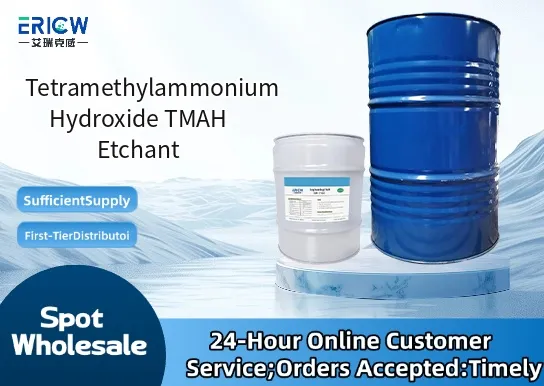
Highly anisotropic silicon etching with exceptional selectivity to silicon dioxide and silicon nitride.
Non-oxidizing, low-metal-content formulation ideal for microelectronics and MEMS fabrication.
Stable aqueous solution with consistent etch rate control across temperature and concentration ranges.
Low surface tension and minimal residue formation, enabling clean post-etch wafer processing.
Compatible with standard photolithography resists and hard masks without significant undercut or swelling.
Deep reactive ion etch (DRIE) stop layer etching in MEMS sensor fabrication.
Anisotropic etching of <100> silicon wafers for microfluidic channel structuring.
Release etching of silicon-based microstructures in accelerometers and gyroscopes.
Wafer-level packaging processes requiring precise cavity definition and sidewall smoothness.
Research and development of nanoscale silicon devices including NEMS and photonic crystals.
| Chemical Type | Quaternary ammonium hydroxide |
| Product Form | Aqueous solution (typically 5–25 wt% TMAH) |
| Appearance | Clear, colorless to pale yellow liquid |
| Melting Point | -5 °C (for 25 wt% aqueous solution) |
| pH (25 °C, 10 wt%) | ≥13.5 |
| Primary Applications | Silicon micromachining, MEMS, semiconductor R&D |
| Key Features | Anisotropic etching, thermal stability, low particle count |
| Regulatory Compliance | REACH registered; SDS available per OSHA HCS and GHS standards |
| Common Compatible Systems | Suitability |
| Standard quartz or glass etch baths (e.g., Pyrex® tanks) | Highly Recommended – Chemically inert and thermally stable up to 90 °C |
| Stainless steel 316L recirculation systems with PFA-lined piping | Recommended – Requires passivation and continuous pH monitoring |
| PP (polypropylene) and PVDF wet benches | Suitable – Acceptable for ambient-temperature batch processing |
| Automated single-wafer spin etchers with Teflon® process chambers | Highly Recommended – Minimal leaching and compatible with precision dispense control |
Q1: What is the CAS Number for Tetramethylammonium Hydroxide (TMAH)?
A: The CAS Number for tetramethylammonium hydroxide monohydrate is 75-59-2; anhydrous form is 10424-60-9.
Q2: What is the typical working concentration and temperature range for optimal silicon etch performance?
A: Standard operating conditions are 10–20 wt% TMAH at 70–90 °C, delivering etch rates of 0.5–2.5 µm/min on <100> silicon with high reproducibility.
Q3: How does TMAH compare to KOH in terms of selectivity and safety profile?
A: TMAH offers superior selectivity to SiO₂ (>500:1) versus KOH (~100:1), lower vapor pressure, reduced inhalation hazard, and compatibility with aluminum metallization layers.
Q4: Does TMAH exhibit extractable amines or quaternary ammonium residues after rinsing?
A: Residual TMAH is readily removed by deionized water rinse; no persistent amine migration occurs when standard post-etch cleaning (SC1 or dilute citric acid) is applied.
Q5: Is this product certified for use in ISO Class 5 (Class 100) cleanroom environments?
A: Yes — manufactured under ISO 9001 and ISO 14644-1 compliant facilities; filtered to ≤0.1 µm and tested for ≤10 particles/mL (≥0.5 µm) per JIS B 9921.
Contact With Us:
E-mail: wangxingqiang@ericwchem.com
Have a Questions? Call Us:
Add:
Building A1, Jiete Industrial Park, Huangpu District, Guangzhou City, Guangdong Province, China