English
 Español
 tiếng việt
 русский
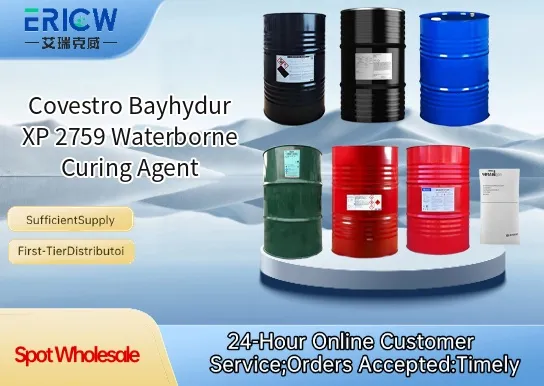
High-performance aliphatic polyisocyanate dispersion for waterborne two-component polyurethane systems.
Excellent hydrolytic stability and storage stability in aqueous media.
Enables low-VOC, high-gloss, and durable coatings with outstanding weather resistance.
Good compatibility with a broad range of waterborne polyacrylate and polyurethane dispersions.
Fast ambient-cure capability without requiring forced drying or high-temperature ovens.
Architectural and industrial maintenance coatings.
Waterborne wood coatings for furniture and flooring.
Automotive refinish clearcoats and basecoats.
Plastic coatings for automotive interior trim and consumer electronics.
High-performance can and coil coatings requiring low environmental impact.
| Chemical Type | Aliphatic polyisocyanate (HDI-based) dispersion |
| Product Form | White to slightly yellow opaque liquid |
| Appearance | Homogeneous dispersion, no phase separation |
| Solids Content (wt. %) | 45 ± 2 |
| pH | 7.0 – 8.5 |
| Viscosity (mPa·s, 23 °C, Brookfield RVT, spindle #3, 10 rpm) | 150 – 400 |
| NCO Content (wt. %) | 6.5 – 7.2 |
| Primary Applications | Two-component waterborne PU coatings |
Q1: What is the primary function of Bayhydur XP 2759 in waterborne coating systems?
A: Bayhydur XP 2759 is a water-dispersible polyisocyanate curing agent designed to crosslink hydroxyl-functional waterborne resins—such as acrylics, polyesters, or hybrid dispersions—enabling ambient- or low-bake-cure performance with excellent film hardness, chemical resistance, and gloss retention.
Q2: Can Bayhydur XP 2759 be used in direct-to-metal (DTM) applications?
A: Yes—it is commonly formulated into DTM waterborne coatings for industrial maintenance and general metal protection, where its good compatibility with waterborne binders and balanced reactivity support robust adhesion, corrosion resistance, and recoatability without requiring primer layers.
Q3: How does Bayhydur XP 2759 compare to solvent-based polyisocyanate curing agents in terms of pot life and application window?
A: As a waterborne system, it offers extended pot life compared to many reactive solvent-based counterparts—especially under controlled humidity and temperature conditions—due to its blocked or encapsulated isocyanate functionality and tailored dispersion stability. Actual working time depends on formulation pH, co-solvent content, and ambient conditions.
Q4: Is Bayhydur XP 2759 compatible with amine-containing additives or pigments?
A: Careful evaluation is required—amines can accelerate isocyanate reactions or cause viscosity instability. It is generally recommended to avoid strongly basic additives and to conduct compatibility testing when using amine-based dispersants, catalysts, or certain functional pigments.
Contact With Us:
E-mail: wangxingqiang@ericwchem.com
Have a Questions? Call Us:
Add:
Building A1, Jiete Industrial Park, Huangpu District, Guangzhou City, Guangdong Province, China