English
 Español
 tiếng việt
 русский
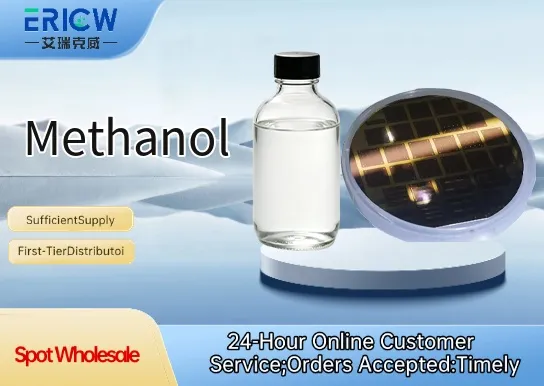
High-purity, anhydrous grade suitable for laboratory and industrial synthesis.
Excellent solvent power for resins, dyes, inks, and cellulose derivatives.
Low boiling point (64.7 °C) enables efficient recovery and recycling in closed-loop processes.
Renewable production pathways available via biomass gasification or CO₂ hydrogenation.
Consistent batch-to-batch quality with strict trace metal and water content control.
Feedstock for formaldehyde, acetic acid, methyl tert-butyl ether (MTBE), and olefins (MTO process).
Solvent in coatings, adhesives, cleaning agents, and pharmaceutical manufacturing.
Antifreeze and de-icing agent in natural gas processing and pipeline systems.
Fuel blending component and marine fuel alternative (in compliant dual-fuel engines).
Extraction medium for essential oils, alkaloids, and botanical actives in fine chemical production.
| Chemical Type | Organic compound; primary alcohol |
| Product Form | Clear, colorless liquid |
| Appearance | Transparent, free from suspended matter |
| Melting Point | −97.6 °C |
| Boiling Point (at 760 mmHg) | 64.7 °C |
| Density (20 °C) | 0.791–0.792 g/cm³ |
| Water Content (max) | 0.1% w/w |
| Regulatory Compliance | Meets ASTM D1152 (Grade AA) and ISO 6387 standards |
| Common Compatible Systems | Suitability |
| Stainless steel (304, 316) | Highly Recommended – Excellent corrosion resistance under dry and aqueous conditions |
| Aluminum alloys (e.g., 5052, 6061) | Recommended – Suitable for short-term storage; avoid prolonged exposure above 40 °C |
| Viton® (FKM) and EPDM elastomers | Recommended – Good seal compatibility; EPDM preferred for low-temperature service |
| Polyethylene (HDPE) and polypropylene (PP) | Suitable – Acceptable for ambient-temperature containment; not recommended for pressurized or elevated-temp service |
Q1: What is the CAS Registry Number for methanol?
A: The CAS Registry Number for methanol is 67-56-1.
Q2: Can methanol be used as a direct substitute for ethanol in extraction processes?
A: Methanol offers higher polarity and solvation strength than ethanol for many polar compounds, but it is not approved for food or pharmaceutical extracts due to toxicity concerns; regulatory approval and residue validation are required prior to use.
Q3: Does methanol migrate from packaging into stored products, and how is this controlled?
A: Migration risk is low with compatible packaging (e.g., HDPE, stainless steel); however, permeation through certain polymers (e.g., LDPE, PVC) may occur over time—validated compatibility testing per ISO 10993-12 or USP <87>/<88> is recommended for regulated applications.
Q4: Is your methanol REACH registered and compliant with TSCA?
A: Yes—our methanol is fully REACH registered (EU ECHA No. 01-2119466123-38-0002) and listed on the U.S. TSCA Inventory (CAS 67-56-1).
Contact With Us:
E-mail: wangxingqiang@ericwchem.com
Have a Questions? Call Us:
Add:
Building A1, Jiete Industrial Park, Huangpu District, Guangzhou City, Guangdong Province, China