English
 Español
 tiếng việt
 русский
High resistance to aggressive automotive fluids including modern low-SAPS engine oils and biofuels.
Excellent heat resistance up to 230 °C for continuous service, with outstanding thermal aging stability.
Superior compression set resistance, maintaining sealing performance under prolonged high-temperature compression.
Good processability in standard rubber compounding and molding equipment, enabling efficient production.
Low-temperature flexibility down to –20 °C, supporting reliable function in wide ambient operating ranges.
Static and dynamic O-rings and gaskets in advanced powertrain systems (e.g., turbocharger seals, EGR valves).
Fuel system components including injector seals, rail connectors, and fuel pump diaphragms.
Under-hood sealing solutions exposed to hot oil, coolant, and exhaust gas recirculation environments.
Valve stem seals and crankshaft front/rear main seals in high-efficiency internal combustion engines.
Sealing elements in hybrid electric vehicle (HEV) power electronics cooling circuits.
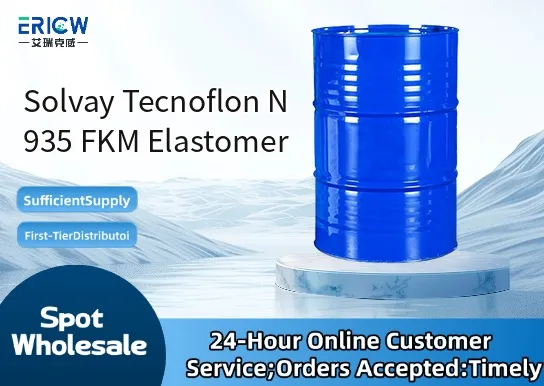
| Chemical Type | Fluoroelastomer (FKM), vinylidene fluoride–hexafluoropropylene–tetrafluoroethylene terpolymer |
| Product Form | Uncured gum stock in bale form |
| Appearance | Light tan to amber colored, smooth-surfaced elastomeric bale |
| Primary Applications | High-performance static and dynamic seals in automotive powertrain and fluid handling systems |
| Key Features | Enhanced hydrolytic stability, low compression set, broad chemical resistance |
| Benefits | Extended service life in demanding thermal/chemical environments; compatibility with automated molding processes |
| Processing Guidance | Designed for conventional sulfur or peroxide curing systems; requires standard FKM processing equipment |
| Regulatory Compliance | Meets ASTM D1418 classification FKM; compliant with ISO 2917 and SAE J200 standards |
Q1: What distinguishes Tecnoflon N 935 from other FKM elastomers in terms of processing and cure characteristics?
A: Tecnoflon N 935 is a low-viscosity, peroxide-curable fluoroelastomer designed for excellent processability in high-shear mixing and extrusion. Its lower Mooney viscosity enables easier dispersion of fillers and curatives, and it typically achieves fast, efficient crosslinking with standard peroxide systems—reducing scorch risk and supporting high-throughput molding operations.
Q2: Is Tecnoflon N 935 suitable for applications requiring resistance to aggressive automotive fluids and high-temperature exposure?
A: Yes—Tecnoflon N 935 delivers outstanding resistance to modern engine oils, transmission fluids, brake fluids (including DOT 4 and DOT 5.1), and coolant formulations, even under continuous service temperatures up to 200 °C. Its high fluorine content and stable carbon–fluorine backbone provide superior thermal and chemical stability compared to many standard FKM grades.
Q3: Can Tecnoflon N 935 be used in dynamic sealing applications such as turbocharger hoses or valve stem seals?
A: Absolutely—its balanced combination of low compression set, high resilience, and excellent flex fatigue resistance makes it well-suited for demanding dynamic seals. It maintains dimensional stability and sealing force over extended cycles, especially in environments subject to rapid thermal cycling and mechanical stress.
Q4: How does Tecnoflon N 935 perform in contact with polar solvents and low-molecular-weight esters commonly found in industrial lubricants?
A: Tecnoflon N 935 exhibits significantly improved resistance to polar solvents—including ketones, esters, and amides—compared to conventional bisphenol-cured FKMs. This enhanced compatibility stems from its peroxide-cure chemistry and molecular structure, enabling reliable performance in advanced synthetic lubricant systems where traditional FKMs may swell or degrade.
Contact With Us:
E-mail: wangxingqiang@ericwchem.com
Have a Questions? Call Us:
Add:
Building A1, Jiete Industrial Park, Huangpu District, Guangzhou City, Guangdong Province, China