English
 Español
 tiếng việt
 русский
High reactivity with formaldehyde and melamine-based crosslinkers for rapid cure development.
Excellent compatibility with acrylic, polyester, and alkyd resin systems in solventborne coatings.
Provides superior hardness, gloss retention, and chemical resistance in thermoset coatings.
Low volatile organic compound (VOC) contribution when formulated with optimized solvent blends.
Consistent batch-to-batch performance ensured by INEOS’s controlled manufacturing process.
Automotive OEM clearcoats and basecoat/clearcoat systems.
Industrial coil coatings for pre-painted metal substrates.
Appliance finishes requiring high durability and mar resistance.
General-purpose can coatings for food and beverage containers.
Wood furniture and cabinetry coatings with enhanced scratch resistance.
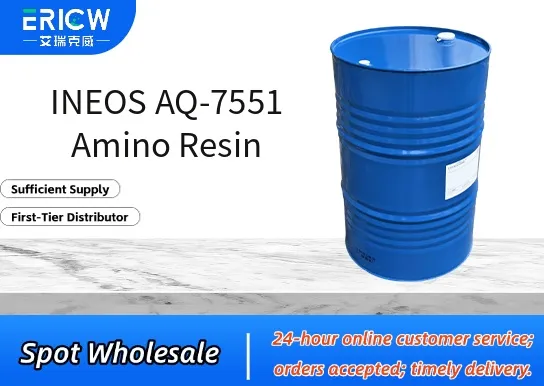
| Chemical Type | Methylolated melamine-formaldehyde resin |
| Product Form | Liquid |
| Appearance | Clear, pale yellow to colorless liquid |
| Solvent Content | Approx. 60–65% (isobutanol/butyl acetate blend) |
| Non-Volatile Content (NV%) | 35–40% (by weight, 105°C, 60 min) |
| pH (10% in water) | 7.8–8.5 |
| Viscosity (25°C, Brookfield RVT, #3 spindle, 20 rpm) | 150–300 mPa·s |
| Storage Stability | ≥12 months at 5–30°C in sealed container |
Q1: What is the primary function of INEOS AQ-7551 in coating formulations?
A: INEOS AQ-7551 is a water-dispersible amino resin designed to act as a crosslinking agent for hydroxyl-functional resins—such as acrylics, polyesters, or alkyds—in low-VOC, aqueous baking coatings. It enhances hardness, chemical resistance, and film integrity upon thermal cure.
Q2: Is AQ-7551 suitable for food-contact coating applications?
A: While AQ-7551 is formulated for high-purity performance and low extractables, its suitability for food-contact applications depends on full formulation compliance and final regulatory evaluation by the end-user. It is not pre-certified for specific food-contact regulations; customers must validate compliance within their complete system and intended use conditions.
Q3: How does AQ-7551 differ from traditional melamine-formaldehyde resins in terms of handling and stability?
A: Unlike many solvent-based melamine resins, AQ-7551 is supplied as a stable, ready-to-use aqueous dispersion with inherent pH buffering and reduced free formaldehyde content. It offers improved storage stability at ambient temperatures and simplified integration into waterborne systems without requiring organic co-solvents or extensive pH adjustment.
Q4: What is the typical curing temperature range for coatings containing AQ-7551?
A: AQ-7551 is engineered for thermal crosslinking in standard industrial baking ovens. Effective cure generally occurs between 120 °C and 160 °C, with time-on-temperature dependent on film thickness, substrate, and overall formulation balance. Lower-temperature cure may be achievable with catalysis, but requires formulation optimization.
Q5: Can AQ-7551 be used in combination with other crosslinkers or additives?
A: Yes—AQ-7551 is compatible with common coating additives (e.g., dispersants, defoamers, rheology modifiers) and can be co-formulated with complementary crosslinkers such as blocked isocyanates or other amino resins, provided compatibility and cure kinetics are verified experimentally. Blending should be evaluated for colloidal stability and final film performance.
Contact With Us:
E-mail: wangxingqiang@ericwchem.com
Have a Questions? Call Us:
Add:
Building A1, Jiete Industrial Park, Huangpu District, Guangzhou City, Guangdong Province, China