English
 Español
 tiếng việt
 русский
Excellent abrasion resistance for demanding dynamic applications.
Outstanding low-temperature flexibility down to –40 °C.
Good hydrolytic stability, suitable for humid or wet-service environments.
High melt flow index enabling efficient processing via injection molding and extrusion.
Translucent natural color with consistent batch-to-batch clarity and appearance.
Medical tubing and fluid handling components requiring biocompatibility support.
Consumer electronics protective cases and wearable device housings.
Automotive interior trim, seals, and soft-touch overmolded parts.
Industrial hoses, bellows, and flexible connectors exposed to mechanical stress.
Footwear midsoles and outsoles requiring rebound resilience and comfort.
| Chemical Type | Aliphatic polyester-based thermoplastic polyurethane (TPU) |
| Product Form | Pellets |
| Appearance | Translucent, natural-colored pellets |
| Primary Applications | Extrusion, injection molding, and overmolding |
| Key Features | Abrasion resistance, low-temperature flexibility, hydrolytic stability |
| Processing Temperature Range | 180–220 °C (recommended melt temperature) |
| Density (ASTM D792) | 1.18–1.20 g/cm³ |
| Melt Flow Index (2.16 kg, 200 °C, ASTM D1238) | 10–14 g/10 min |
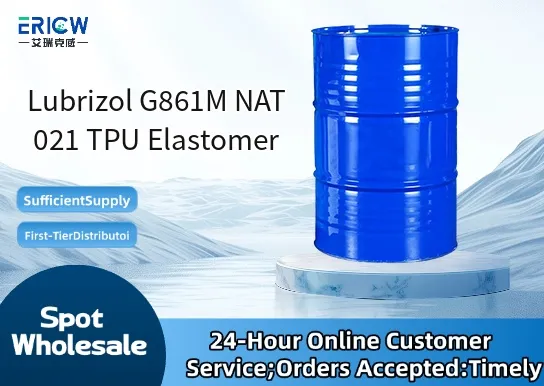
Q1: What is the primary function of Lubrizol G861M NAT 021 in TPU formulations?
A: Lubrizol G861M NAT 021 is a specialty additive designed to enhance melt processability and surface quality of thermoplastic polyurethane (TPU) compounds. It functions as a processing aid that reduces melt viscosity and minimizes die buildup during extrusion or injection molding.
Q2: Is G861M NAT 021 compatible with all common TPU chemistries (e.g., polyester-, polyether-, and polycaprolactone-based TPUs)?
A: Yes, G861M NAT 021 has demonstrated broad compatibility across major TPU families, including polyester-, polyether-, and polycaprolactone-based systems. Compatibility should be verified under actual processing conditions due to formulation-specific interactions.
Q3: How is G861M NAT 021 typically incorporated into TPU compounds?
A: It is commonly introduced via dry blending with TPU pellets prior to extrusion or added directly through a gravimetric feeder during compounding. Pre-compounding into a masterbatch is also a viable option for improved dispersion control.
Q4: Does G861M NAT 021 affect the mechanical or thermal properties of the final TPU product?
A: When used at recommended dosage levels, G861M NAT 021 generally preserves key mechanical performance attributes—including tensile strength, elongation, and hardness—while improving process stability. Significant deviations from typical usage ranges may influence low-temperature flexibility or long-term thermal aging behavior.
Contact With Us:
E-mail: wangxingqiang@ericwchem.com
Have a Questions? Call Us:
Add:
Building A1, Jiete Industrial Park, Huangpu District, Guangzhou City, Guangdong Province, China