English
 Español
 tiếng việt
 русский
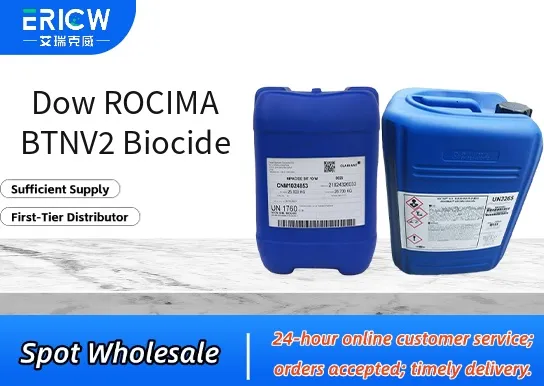
Highly effective broad-spectrum biocide against bacteria, fungi, and algae in industrial water systems.
Stable performance across a wide pH range (pH 4–10) and tolerant to common water treatment additives.
Low foaming formulation suitable for high-shear and recirculating cooling water applications.
Compatible with oxidizing biocides, enabling flexible program integration for enhanced microbial control.
Non-volatile active ingredients ensure sustained residual activity and reduced dosing frequency.
Cooling water systems in power generation and HVAC installations.
Process water circuits in pulp and paper manufacturing facilities.
Recirculating water loops in metalworking fluid sumps and machining operations.
Make-up water treatment for closed-loop industrial cooling towers.
Preservation of aqueous-based industrial formulations during storage and transport.
| Chemical Type | Heterocyclic nitrogen-containing biocide blend |
| Product Form | Aqueous liquid concentrate |
| Appearance | Clear to slightly hazy, pale yellow liquid |
| pH (as supplied) | 7.5 – 9.0 |
| Density (20 °C) | 1.02 – 1.06 g/cm³ |
| Solubility in Water | Completely miscible |
| Primary Applications | Cooling water, process water, metalworking fluids, industrial preservative |
| Key Features | Broad-spectrum efficacy, low-foam, pH-stable, non-oxidizing |
Q1: What is Dow ROCIMA BTNV2 Biocide primarily used for?
A: Dow ROCIMA BTNV2 Biocide is a broad-spectrum, water-based biocide formulated for the preservation of water-miscible industrial formulations, including metalworking fluids, latex paints, adhesives, and other aqueous systems prone to microbial degradation.
Q2: Is BTNV2 compatible with common surfactants and thickeners found in coatings and industrial fluids?
A: Yes, BTNV2 demonstrates good compatibility with a wide range of anionic, nonionic, and amphoteric surfactants, as well as common rheology modifiers such as hydroxyethyl cellulose (HEC) and associative thickeners—though compatibility testing under actual formulation conditions is always recommended.
Q3: How should BTNV2 be added to a formulation for optimal performance?
A: BTNV2 is typically added during the cool-down phase of formulation, after high-temperature processing steps, to preserve its biocidal activity. It should be introduced with adequate mixing to ensure uniform distribution throughout the aqueous phase.
Q4: Does BTNV2 provide protection against both bacteria and fungi?
A: Yes, BTNV2 offers effective control against a broad spectrum of Gram-positive and Gram-negative bacteria, yeasts, and molds—making it suitable for long-term preservation where both bacterial spoilage and fungal growth are concerns.
Q5: What is the typical dosage range for BTNV2 in industrial applications?
A: Dosage depends on formulation requirements, challenge level, and regulatory considerations, but BTNV2 is generally used at low concentrations—typically ranging from 0.1% to 2% by weight in the final product—based on extensive laboratory and field experience.
Contact With Us:
E-mail: wangxingqiang@ericwchem.com
Have a Questions? Call Us:
Add:
Building A1, Jiete Industrial Park, Huangpu District, Guangzhou City, Guangdong Province, China