English
 Español
 tiếng việt
 русский
Excellent abrasion resistance for demanding mechanical service life requirements.
Outstanding low-temperature flexibility down to –40 °C without embrittlement.
Good processability via injection molding and extrusion with short cycle times.
High transparency and clarity suitable for aesthetic, light-transmitting components.
Hydrolysis-stabilized formulation for enhanced durability in humid or wet environments.
Medical tubing and fluid-handling components requiring biocompatibility support.
Consumer electronics protective cases and soft-touch overmolding layers.
Automotive interior trim, seals, and decorative gaskets.
Industrial hoses and pneumatic connectors needing elasticity and pressure resilience.
Wear-resistant footwear components including midsoles and outsole overlays.
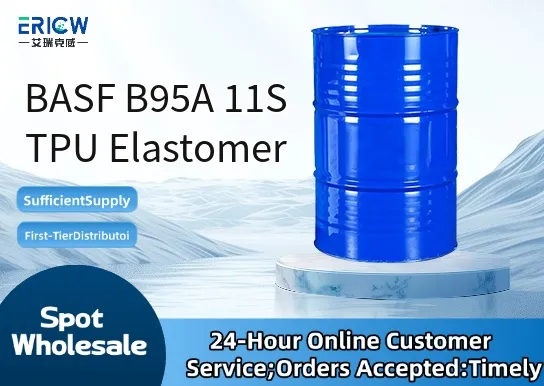
| Chemical Type | Aliphatic polyester-based thermoplastic polyurethane (TPU) |
| Product Form | Pellets |
| Appearance | Translucent, off-white granules |
| Primary Applications | Extrusion, injection molding, overmolding |
| Key Features | Hydrolysis resistance, low-temperature toughness, optical clarity |
| Processing Temperature Range | 180–220 °C (recommended melt temperature) |
| Density (ISO 1183) | 1.18–1.20 g/cm³ |
| Shore A Hardness (ISO 7619-1) | 95 ± 2 |
Q1: What are the key processing methods suitable for BASF B95A 11S TPU Elastomer?
A: BASF B95A 11S is specifically engineered for melt processing techniques including injection molding, extrusion, and blow molding. Its balanced melt viscosity and thermal stability support consistent flow and good surface finish across standard thermoplastic equipment, without requiring specialized drying beyond typical TPU preconditioning.
Q2: How does B95A 11S compare to other TPU grades in terms of hardness and flexibility?
A: B95A 11S is a medium-hardness thermoplastic polyurethane elastomer, offering a favorable balance between rigidity and elasticity. It delivers higher tensile strength and better abrasion resistance than softer TPU grades, while maintaining greater flexibility and impact resilience compared to rigid engineering thermoplastics like rigid PVC or certain polyesters.
Q3: Is B95A 11S compatible with common polymer blends or overmolding substrates?
A: Yes — B95A 11S exhibits good adhesion to a range of thermoplastics such as polypropylene (PP), polyethylene (PE), and ABS when used in two-shot molding or co-extrusion applications. Compatibility in blends depends on thermal history and interfacial compatibility; pilot trials are recommended to verify bond integrity and phase dispersion under intended processing conditions.
Q4: What are the primary end-use considerations for products made with B95A 11S?
A: Components made from B95A 11S are commonly deployed in dynamic applications requiring repeated flexing, moderate chemical exposure, and reliable mechanical recovery — such as seals, gaskets, protective casings, and flexible tubing. Its inherent resilience and low-temperature performance make it especially relevant for industrial and automotive components operating across variable ambient conditions.
Contact With Us:
E-mail: wangxingqiang@ericwchem.com
Have a Questions? Call Us:
Add:
Building A1, Jiete Industrial Park, Huangpu District, Guangzhou City, Guangdong Province, China