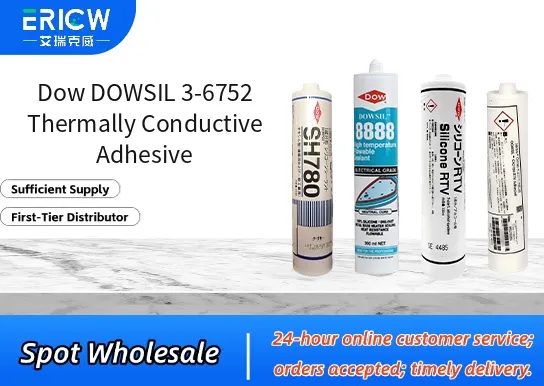
Features Of Dow DOWSIL 3-6752 Thermally Conductive Adhesive
High thermal conductivity (1.5 W/m·K) for efficient heat dissipation in demanding electronic assemblies.
Room-temperature vulcanizing (RTV) silicone adhesive with low modulus, enabling stress relief and long-term reliability under thermal cycling.
Excellent adhesion to diverse substrates including aluminum, copper, ceramics, and FR-4 PCBs without primers.
UL 94 V-0 rated for flame resistance, supporting compliance in safety-critical applications.
Non-corrosive formulation—free of halogens, phosphorus, and sulfur—to protect sensitive electronic components.
Typical Applications Of Dow DOWSIL 3-6752 Thermally Conductive Adhesive
Thermal interface bonding of power electronics modules (e.g., IGBTs, MOSFETs) to heat sinks.
Attachment of LED packages and COB (chip-on-board) arrays in high-brightness lighting systems.
Die-attach and heat sink mounting in automotive ADAS sensors and onboard chargers.
Thermal management of 5G RF power amplifiers and base station components.
Permanent bonding of battery cell monitoring units (BMUs) and thermal interface layers in EV battery packs.
Specifications Of Dow DOWSIL 3-6752 Thermally Conductive Adhesive
| Chemical Type | Platinum-cured addition-cure silicone |
| Product Form | Two-part paste (Part A: filler-rich base; Part B: catalyst) |
| Appearance | Gray, homogeneous paste |
| Primary Applications | Structural thermal bonding and gap-filling in electronics |
| Key Features | Thermally conductive, electrically insulating, low-stress cure |
| Benefits | Eliminates need for mechanical fasteners; reduces assembly time and thermal interface resistance |
| Cure Profile | Room temperature (7 days) or accelerated at 80°C (30 min) |
| Storage Stability | 12 months at ≤25°C (unopened) |
Dow DOWSIL 3-6752 Thermally Conductive Adhesive – Frequently Asked Questions (FAQ)
Q1: What substrates does DOWSIL 3-6752 bond well to?
A: DOWSIL 3-6752 exhibits strong adhesion to a broad range of engineering substrates including aluminum, copper, stainless steel, nickel-plated surfaces, and common thermoplastics and thermosets used in electronics packaging—such as PPA, LCP, and epoxy molding compounds. Surface preparation (e.g., cleaning and optional plasma treatment) is recommended to optimize bond strength and long-term reliability.
Q2: How is DOWSIL 3-6752 typically cured, and what are the key processing considerations?
A: This adhesive is designed for thermal cure, typically requiring elevated temperature exposure (e.g., 120–150 °C for 30–90 minutes), though full cure profiles may vary depending on part geometry, thickness, and equipment capabilities. It is not UV-curable or moisture-cure. Proper ventilation and controlled ramp rates are advised to minimize void formation and ensure complete crosslinking.
Q3: Does DOWSIL 3-6752 provide electrical insulation while enabling thermal conduction?
A: Yes—DOWSIL 3-6752 is formulated as an electrically insulating, thermally conductive adhesive. It maintains high dielectric strength and volume resistivity while efficiently transferring heat between components, making it suitable for applications where electrical isolation between adjacent conductive surfaces is critical—such as power module assembly and LED heat sink bonding.
Q4: Can DOWSIL 3-6752 withstand thermal cycling and long-term aging in harsh environments?
A: DOWSIL 3-6752 demonstrates robust performance under thermal cycling (e.g., -40 °C to +150 °C) and extended high-temperature exposure, retaining mechanical integrity and thermal interface stability. Its silicone-based chemistry contributes to excellent resistance to humidity, oxidation, and thermal degradation—supporting reliable operation in demanding automotive, industrial, and power electronics applications.
 English
 Español
 tiếng việt
 русский